
A beauty bundle can make a useful choice easier. It can also combine products that do not belong together, hide a weak offer behind a discount, or create a fulfillment problem the store has not priced in.
The right question is not whether bundles raise average order value. It is whether the set solves a specific customer task and still works after product, packaging, fulfillment, promotion, returns, and service costs are counted. For a founder, that decision starts with the job the kit is meant to do.
Give the set a clear job
Most beauty bundles serve one or more of these customer needs:
- A gift: the buyer wants a present that feels considered and is easy to choose. The set needs a clear recipient or occasion, readable contents, and packaging that suits how it will be given.
- A routine: the buyer wants related products that can be used together. Explain the sequence and what each item contributes, without implying that every customer needs every step.
- Discovery: the buyer wants to sample a brand or category before choosing a full-size item. Smaller formats or a balanced mix can lower the commitment if the products and availability support it.
- A service or retail add-on: the set extends a salon or makeup service with products the customer has seen demonstrated. The fit depends on whether staff can explain it and whether the products make sense after the appointment.
These are merchandising hypotheses, not guaranteed conversion mechanisms. A set should make the customer’s choice clearer. If the products do not share a use, audience, occasion, or useful contrast, the bundle may add more explanation than value.
Choose a bundle format that matches the operation
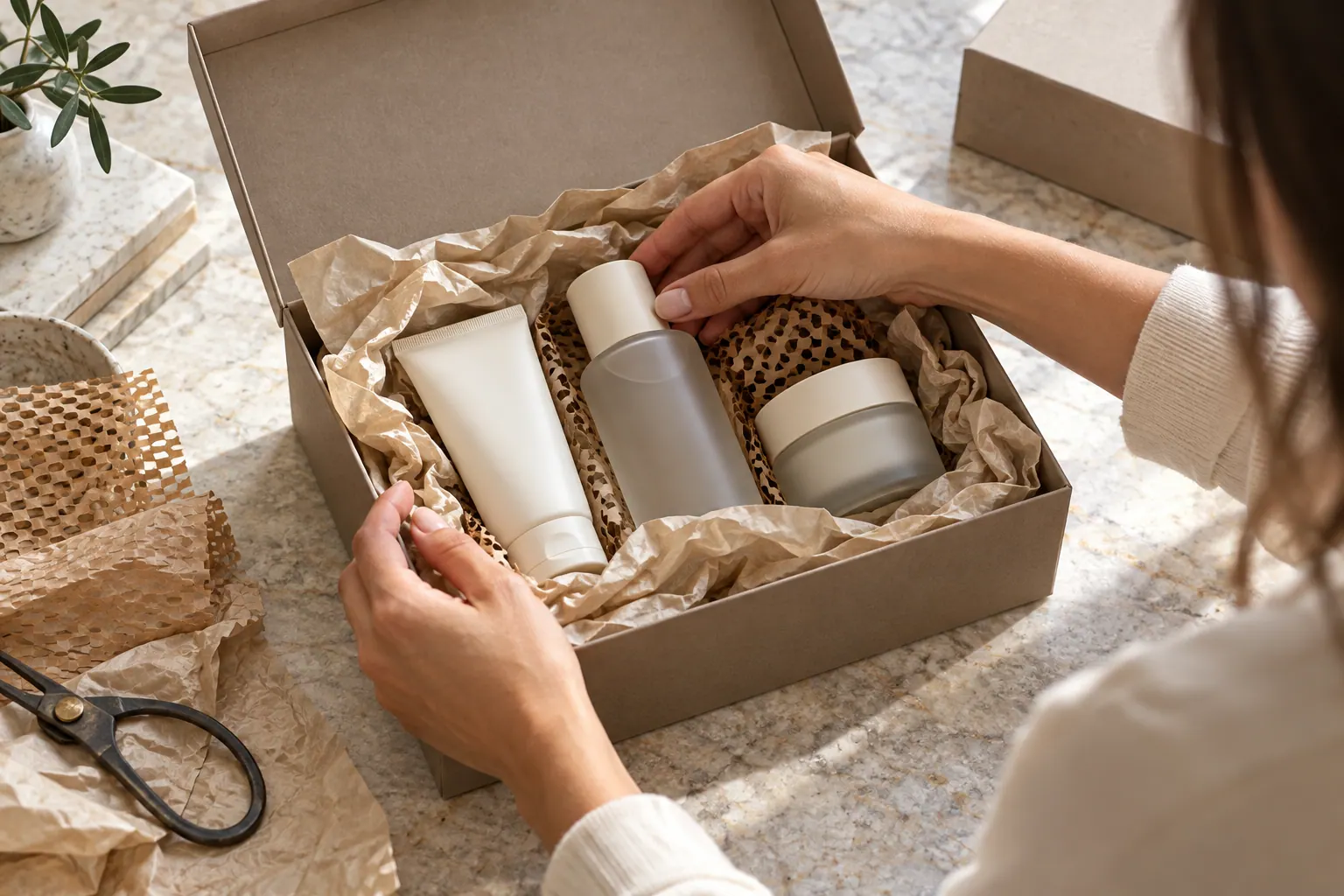
A storefront bundle lets a customer buy multiple existing products together. Items may still be picked and packed when the order arrives. A pre-packed kit is assembled in advance, often into a bag or other container. A custom boxed set adds branded packaging and can require more design work, material cost, and advance inventory.
Blanka’s current help page distinguishes these options. It lists product bundles with no minimum order quantity, pre-packed kits with a 25-kit minimum and a stated US$1.25 assembly fee per kit, and custom boxed kits with a 150-kit minimum plus box costs that vary by design. Those are the supplier’s published terms; confirm the current quote, eligible products, shipping, and agreement before building a launch plan. (Blanka: bundles and pre-packed kits)
Shopify defines a product bundle as two or more related products offered together. Its bundle tools account for component inventory; the available quantity depends on the stock of the required items. Check that each size, shade, or variant in the set is available and that inventory stays synchronized across the storefront and fulfillment process. A bundle listing does not create stock for a component that has sold out. (Shopify: product bundles; Shopify: bundle eligibility and considerations)
Price the complete order
Calculate contribution using the bundle’s actual checkout price and expected fulfillment path:
Contribution before fixed costs = net bundle revenue − component costs − packaging and assembly − fulfillment and shipping subsidy − payment fees − discounts − expected returns or replacements − referral commission.
Compare that result with the contribution from selling the components separately. Include any fixed setup or platform cost in the broader launch decision, but do not count it twice in the per-order calculation. A larger basket can raise revenue per order while lowering contribution if the discount, box, added shipping, or returns cost more than the bundle creates.
A hypothetical example shows the trade-off. Suppose two products priced at $22 each cost the brand $7 and $9, and the combined order has a $4 shipping subsidy plus a 3% payment fee. If one customer would buy both in the same checkout, the order contributes $22.68 before fixed costs. A $39 pre-packed kit with an additional $3 box cost and Blanka’s published $1.25 assembly fee contributes $13.58 under the same shipping assumption. The kit could still help a different buyer choose the set, but that demand must be observed; the higher basket value alone does not recover the discount and packing cost.
Show a reference price only when it is genuine and easy to understand. If the bundle is discounted, tell the customer what each component normally costs and what the set costs, using current prices. Avoid suggesting savings that depend on products that are not available separately or on a price the business does not actually charge.
Before approving the offer, verify a real packed sample. Measure and weigh the completed parcel, check how the products sit together, and request the shipping cost for the destinations the store serves. Packaging dimensions can affect shipping cost and product protection. Use the carrier and fulfillment provider’s current calculation rather than estimating from the component products alone.
Match the set to the customer and channel
A gift set needs enough information for someone buying for another person: contents, sizes, shade or scent options, intended use, and any meaningful limitations. Avoid requiring a gift buyer to know technical product details the page never explains.
A routine kit should be coherent without overstating necessity. If the contents are a cleanser, moisturizer, and lip color, describe how the products fit the intended routine; do not claim that the sequence treats a condition or produces a guaranteed result. For a complexion or color set, list the shades included and show the options clearly.
For a salon or service business, the set can reflect products a professional actually used or demonstrated. Keep a clear distinction between a product sale, a recommendation, and a paid or incentivized endorsement. If a creator receives a free product or other benefit and recommends it, the relationship may need to be disclosed clearly alongside the endorsement under FTC guidance. Rules can differ by market. (FTC: disclosures for social media influencers)

Seasonal sets add a calendar risk. Set the promotion window around confirmed production and shipping times, including time for delays. Decide what happens to packaging or pre-assembled units after the occasion ends. A gift box designed for one holiday may be harder to repurpose than a reusable everyday kit.
Check returns, substitutions, and inventory before launch
A bundle has several components, so the store needs a clear process for missing, damaged, unavailable, or returned items. State whether customers can return the whole set or individual components, how a refund is calculated, and whether substitutions are allowed. Make these terms consistent with the store’s return policy and applicable consumer rules.
If one component becomes unavailable, decide whether the bundle should pause, whether another item can replace it, and how that change will be communicated. Do not silently substitute a different shade or product. Track component inventory as well as the bundle listing, especially when the same products also sell individually.
Test what the bundle is actually improving
Use a product page and offer that let customers understand the set without relying on a discount alone. Track bundle views, selection, completed orders, component availability, contribution per order, returns, and customer questions. Each measure answers a different question: whether shoppers notice the set, understand it, buy it, and receive it as expected.
Compare a bundle with individual products during a similar period and with a similar audience, channel, and promotion. A holiday result versus a quiet month cannot isolate the bundle’s effect.

Put the launch decision on one page
Before publishing the offer, record five things in a short launch brief:
- The promise: who the set is for, what it contains, and what problem or occasion it serves.
- The operating route: whether items are picked per order or assembled in advance, who packs them, and which supplier terms and product variants apply.
- The order math: current set price, component and packaging costs, assembly, payment fees, shipping, expected returns, and contribution compared with separate purchases.
- The customer remedy: what happens when an item is unavailable, arrives damaged, or is returned, including any permitted substitution and refund calculation.
- The decision signal: what evidence will lead the team to keep, revise, or pause the offer, and when that review will happen.
This record makes a weak assumption visible before it becomes a customer promise. Update it when supplier terms, product costs, shipping routes, or the offer change; a bundle that worked under one fulfillment arrangement may not work under another.
Keep, revise, or retire the set based on customer response and contribution—not discount uptake alone.
A strong kit serves a clear customer need. Confirm assembly, delivery, and total cost before presenting the set as a better deal.