
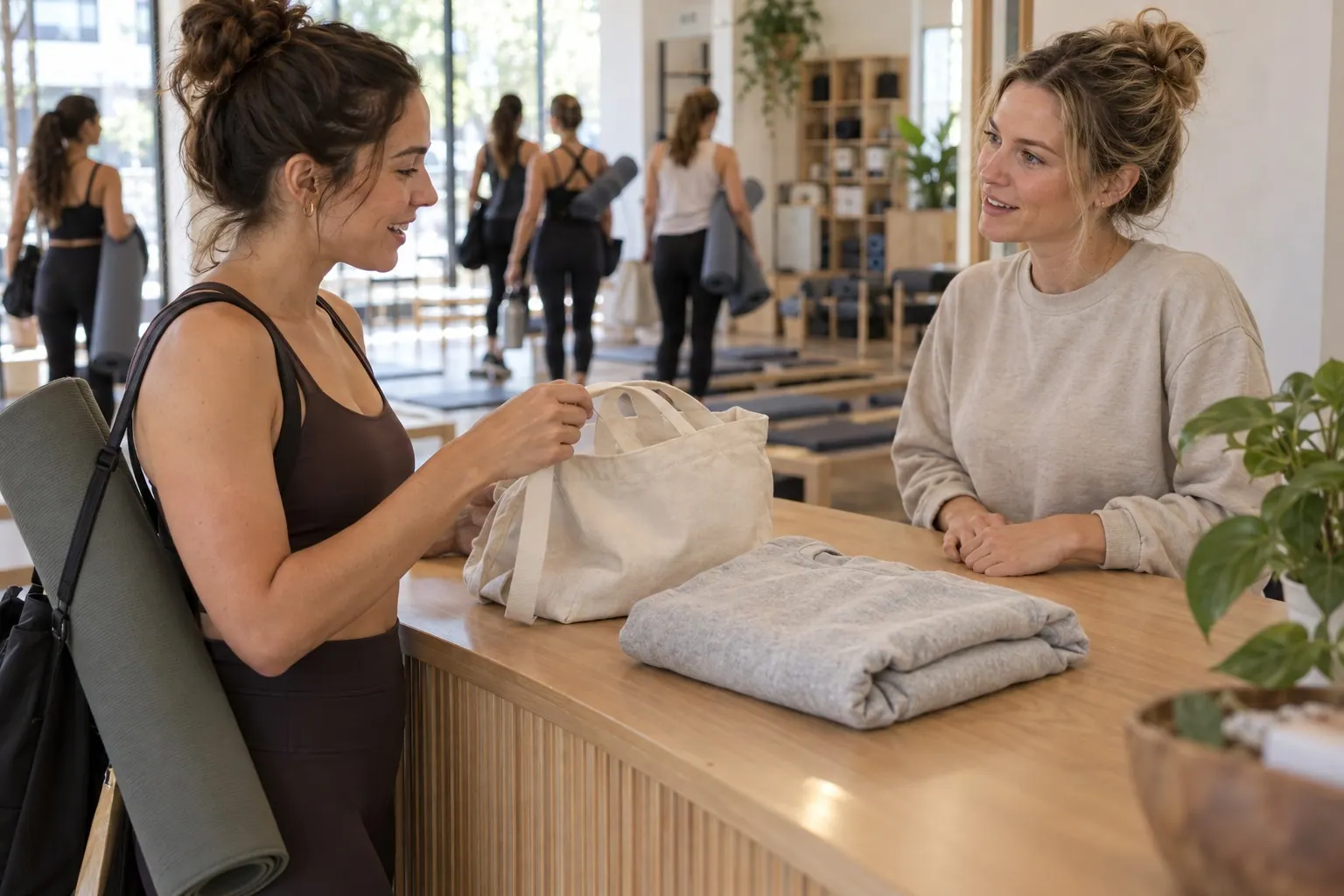
Picture the end of a Pilates class. Members gather their things, greet the instructor, and head out. A branded bottle or tote might fit naturally into this routine. That does not tell us whether anyone wants to buy one, whether the studio can sell it, or whether the owner wants to manage inventory.
For freelancers, gyms, yoga studios, and Pilates businesses can offer several kinds of creative work: staff apparel, event graphics, member merchandise, or a small retail display. Those are possibilities to discuss with an owner, not needs to infer from a busy-looking room or an enthusiastic photo archive.
Before preparing a proposal, confirm whether the studio has a merchandise or apparel need, who owns the decision, and what a paid next step would involve. This guide shows how to verify those points.
Treat the community as context, not evidence of sales
A class schedule, public reviews, and studio photos can help you understand what kind of business you are looking at. They cannot establish member purchasing intent, retail revenue, or a gap in the current offer. A profile may not display products that are sold at the front desk; a photo with branded clothing does not show who purchased it or whether it sold well.
Use public information to prepare a respectful question, then verify the answer with the business. Google’s guidance says Business Profile content must accurately represent the real business, and its photo policy says business imagery should reflect reality. The platform’s terms also govern how content found in its services may be used. That makes profile photos useful for context, not a license to download or reuse someone else’s images, copy reviews into a sales deck, or build a scraped prospect database. See Google’s profile guidelines, photo guidance, content policy, and Terms of Service.
For an initial review, record only details you can verify: the type of classes offered, the public contact route, whether the studio itself mentions apparel or merchandise, and any event or staff program it describes. Avoid labels such as “weak brand,” “untapped community,” or “no product ecosystem.” Those are conclusions, not observations.
Different studios have different buying paths
“Gym” covers businesses with very different structures. An owner-operated yoga studio may make decisions directly. A multi-location franchise may require brand or procurement approval. A nonprofit recreation center may use a formal purchasing process. A strength gym may prioritize staff uniforms, while a Pilates studio may be more interested in an event item or a small front-desk assortment. Verify each case rather than assuming the boutique buys quickly or the larger operator has a larger budget.
Search by service and location—such as “yoga studio [city]” or “Pilates studio [neighborhood]”—to find organizations. Then confirm the organization through its own website or published business contact. Google profile categories and features can change, so do not build a long-term method around a fixed list of category labels. The purpose of the search is to find a relevant conversation, not to generate a large lead count.
Ask what is already happening
Before proposing designs, talk to the person who owns or operates the relevant process. That might be the studio owner, general manager, retail lead, or program coordinator. A short discovery call should clarify:
- The job: Is the need for staff apparel, member merchandise, an event, a welcome item, or a visual refresh of existing products?
- The decision path: Who approves artwork, budget, suppliers, and order quantity? Does a parent brand or committee need to sign off?
- What exists today: What products or vendors are already in use? What parts of ordering, sizing, storage, or reordering are frustrating?
- The practical limits: What is the requested delivery date, spending range, product specification, and ordering route?
- The next step: Is the studio ready to review a paid brief, sample, or proposal? Who will provide feedback and by when?
These questions protect the relationship. An existing supplier may be doing a good job; your role might be to improve artwork consistency, organize an event order, or create a better handoff. If the business is satisfied with its process, there may be no project to sell. A clear “not now” is better information than a speculative pitch.
Make a small scope that can stand on its own
A first assignment should solve one confirmed problem without requiring the studio to accept an entire retail program. The work might be a staff-shirt refresh, an event graphic, or one member product that the owner has already chosen to test. The right choice depends on the conversation, supplier capability, and who will handle production and customer service.
| Possible first project | Freelancer may deliver | Agree before work starts |
|---|---|---|
| Staff apparel refresh | Artwork, placement options, print-ready files, a sizing/order worksheet | Who selects garments, gathers sizes, orders replacements, and approves the final mark? |
| Event item | Event graphic, approved adaptations, production specifications | Who approves event and sponsor marks, quantity, delivery date, and distribution? |
| Member product test | Mockup, product comparison, approved artwork, supplier quote coordination | Who chooses the supplier, pays production costs, holds stock, handles returns, and sets price? |
| Retail display improvement | Product hierarchy, simple signage, and an arrangement proposal | Who owns the space, installs the display, and updates it after products change? |
These are examples of bounded services, not a package every studio needs. Price the design and coordination work separately from production costs, shipping, taxes, payment fees, and any inventory the studio chooses to buy. Quote from current specifications and supplier prices; do not imply that a mockup confirms garment quality or that a supplier estimate is guaranteed until its conditions are checked.
Before anything enters production, confirm who has authority to approve the studio name, logo, and any outside marks. Identify the final approver and keep sign-off on the production artwork in writing. If the client asks you to handle ordering or customer inquiries, spell out those responsibilities and adjust the fee and schedule to match.
Test interest with information the studio owns
If the owner wants to evaluate member merchandise, begin with information the business can legitimately access: recent order records, product questions staff already receive, returns, sizing requests, and the time spent managing the current process. If there is no history, frame the first step as a learning exercise, not a forecast.
The studio might ask members for feedback through its existing channels, show a clearly labeled concept, or run a small order after it has chosen a supplier and documented fulfillment terms. The studio should decide how to communicate price, timing, size availability, returns, and what happens if an item is delayed. A small poll or a few conversations can surface preferences; it does not establish that the entire membership will purchase.
Do not treat class attendance, social engagement, public reviews, or a full room in a photograph as a substitute for orders or direct feedback. Avoid presenting a few responses as a representative survey. The strongest proposal is honest about what is known, what remains uncertain, and how a low-risk next step could answer the open question.
Do not sell recurring drops as guaranteed revenue
Seasonal colors, challenge events, and onboarding materials may create future design work if the studio requests them. They do not automatically create a monthly retainer. A studio may prefer to order once a year, use its existing supplier, or decide that merchandise adds more work than value.
If ongoing support makes sense, define the service in terms the studio can approve: a set number of design updates, event graphics, or ordering-support hours during a stated period. Specify what counts as a revision, what happens when a deadline moves, and whether supplier communication is included. Revisit the arrangement after the first delivery using the studio’s own experience and records. Renew only when both parties see a continuing need.
Write outreach from a real observation
Do not send an email claiming the owner has a waitlist, inconsistent clothing, or demand for branded products unless the studio has publicly stated that fact or confirmed it with you. Avoid offering a free custom collection before a conversation; the work can become unpaid speculative design and may rely on marks you are not authorized to use.
A better first note is simple:
Hi [name] — I found [studio] while looking for Pilates businesses in [area]. I work on small apparel and merchandise projects for local service businesses, including production-ready artwork and supplier coordination. Do you handle staff apparel or member products? If you are reviewing that process this season, I’d be glad to ask a few questions and see whether a defined project would help. If someone else owns it, could you point me to the right contact?
Personalize only with a detail you have actually verified, such as a class type listed on the studio’s site or a publicly announced event. Use the business contact method it publishes, follow the direct-marketing rules that apply where you operate, and honor requests not to be contacted again.
Keep payments downstream of the agreement
Once the client has approved the scope, deliverables, production responsibilities, and payment terms, choose a billing method that works for both parties. Ruul is one possible payment-request service for freelancers. Its support documentation describes sending a payment link that the client can use without creating a Ruul account; identity checks, payment methods, fees, eligibility, and payout timing remain subject to the current account terms and verification. Consult Ruul’s current explanation of payment requests before relying on any platform detail.
An invoicing service does not secure the client, establish demand, or decide who bears inventory and fulfillment responsibilities. Those points belong in the project agreement before production begins.
The first useful action
Choose one studio you can contact through an official business channel. Ask who handles the specific apparel, event, or merchandise process you can improve. If the person confirms a problem and a next step, prepare a scoped proposal around that problem. If there is no current need, record the answer and move on.
That method is less dramatic than describing a whole vertical as an “untapped market.” It is more useful to a freelancer because it separates the visible community from a qualified project—and a creative idea from work a studio is ready to approve.