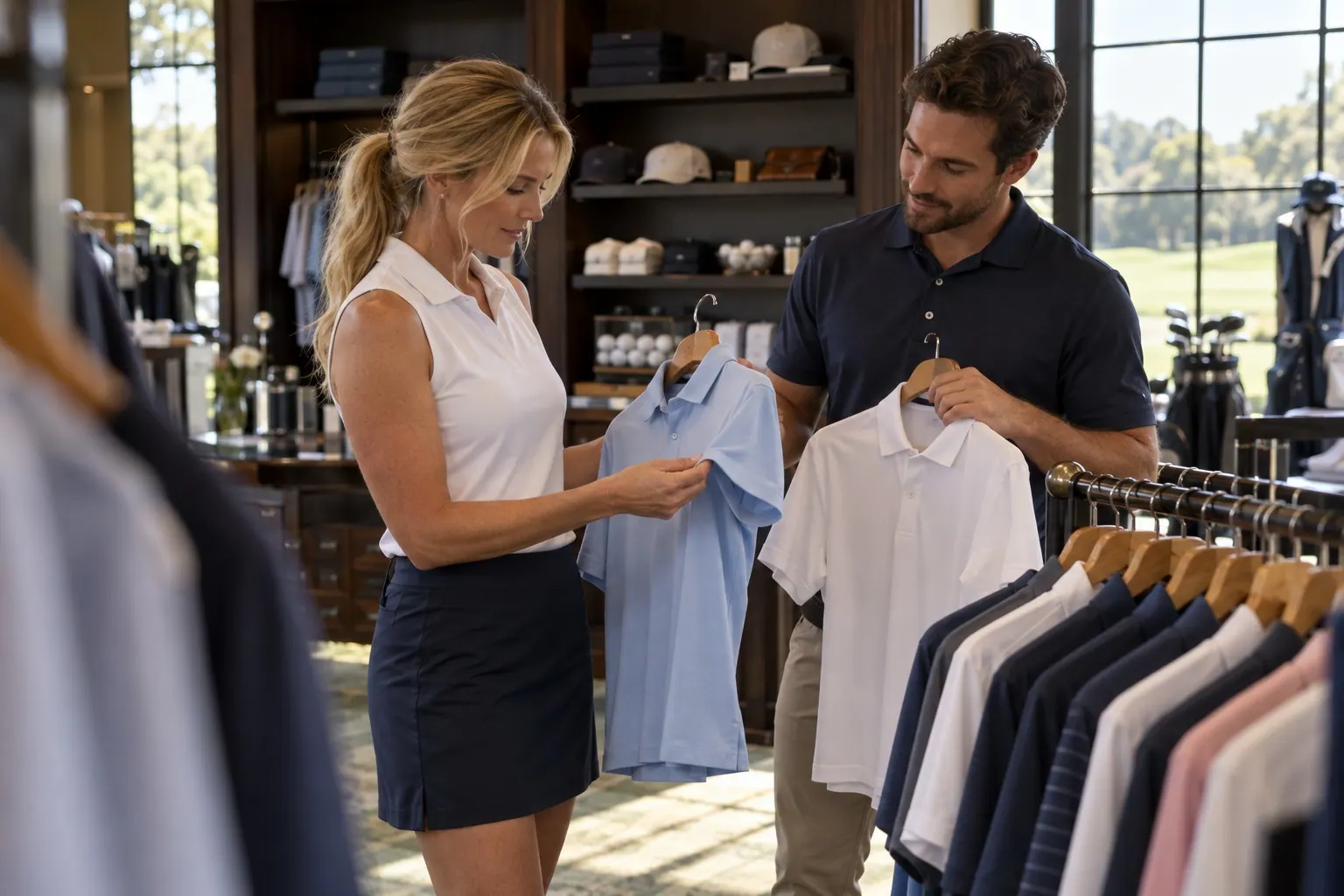
Picture a quiet moment between lessons: a buyer moves a stack of polos aside to compare two samples; through the window, players are finishing a match. It is an ordinary scene, but it contains the real brief: who chooses the garment, who approves the crest, who pays for the stock, and who will be left with it if it does not sell?
For a freelancer, sports clubs can be an appealing client type because apparel touches several parts of the operation: staff identity, member purchases, tournaments, junior programs, and sponsored events. That overlap creates possible design work. It does not prove that a club wants a new collection, that members will buy it, or that every event needs a new shirt.
The useful opportunity is narrower and more practical: help a club clarify what it already needs, who has authority to approve it, and whether a coherent apparel or event system is worth testing.
Start with a question, not a market claim
Golf clubs, tennis academies, pickleball facilities, and multi-sport programs are not one buyer segment. A private club may have a retail shop and a committee. A small academy may sell lesson packages through its front desk. A city recreation program may purchase staff uniforms through a formal procurement process. Similar-looking facilities can have different budgets, approval routes, suppliers, and responsibilities.
That is why “sports clubs need better merchandise” is too broad to guide outreach. Begin with a defined service and a question you can verify:
Does this organization have a current apparel, event-graphics, or merchandise project that is poorly coordinated—and is there a person authorized to discuss improving it?
This wording keeps the freelancer focused on a solvable project. It also leaves room for the answer to be no. A club may already be satisfied with its supplier, may not sell retail items, or may not have a budget this season.
Use public profiles for discovery, not diagnosis
Google Business Profile and a club’s own website can help locate facilities and identify public points of contact. Search terms such as “golf club Austin,” “tennis academy Tampa,” or “pickleball club Scottsdale” are starting points, not a complete market census. Confirm that a result is an operating organization, then visit its own website or contact channel to understand what it actually offers. (Google Business Profile — Guidelines for representing your business)
Photos can show the facility’s public presentation, but they are not a merchandise-demand survey. A photograph of a tournament does not establish attendance, apparel sales, purchasing intent, or who owns the image. A missing online store does not show that a club has no pro-shop inventory. Google’s photo guidance says Business Profile imagery should represent the real business; its content and service terms also govern how content may be used. Treat public material as a cue for a question, not as permission to download images, copy reviews, build a scraped dataset, or present an inference as a fact. Google’s photo guidance and Business Profile content policy explain the platform’s expectations. (Google Terms of Service)
Keep first-pass notes limited to facts you can confirm from an official site or a direct conversation: facility type, programs listed, public retail link if any, contact route, and a specific question to ask. Do not score a business because its photos look old, its reviews mention events, or its website lacks a shop button. Those observations may help you choose what to ask; they do not demonstrate a buying gap.
Find the actual project and the person responsible
Before proposing a collection, ask how the current process works. A short discovery conversation can cover five areas:
- Purpose: Is the request for staff clothing, member retail, a tournament, a junior program, sponsor fulfillment, or a combination?
- Ownership: Who selects products, artwork, supplier, and quantities? Who can approve the design and spend?
- Current process: What is already working? Where do delays, inconsistent artwork, sizing questions, or reorders create extra work?
- Constraints: What dates, vendors, budget range, brand standards, accessibility needs, or procurement steps matter?
- Evidence of fit: Is there an agreed project, an internal sponsor, and a next step such as a paid brief or sample review?
These questions often reveal that “the club” is several stakeholders. A general manager may own operations, a head professional may manage the shop, a coach may coordinate team apparel, and a committee may control the crest or budget. Titles vary by organization. Do not assume that the person who answers the phone can approve a project—or that the retail operator is an obstacle. The operator may be the person who understands inventory, supplier terms, customer preferences, and what has failed before.
The goal of outreach is not to diagnose the club from a distance. It is to earn a short conversation with the right person. A useful first message names one service, explains why it may fit the organization, and asks whether that person handles the relevant area. Avoid claiming that members want a product or that the club is losing sales unless the organization has shared evidence for that conclusion.
Make the offer fit the operating model
A merchandise project can range from a small design assignment to a managed retail program. Keep the scope explicit so the club knows what it is buying and you know what responsibility you are accepting.
| Scope | Possible deliverables | Questions to settle before quoting |
|---|---|---|
| Event identity | Event mark, artwork adaptations, approved print files | Who owns the event identity? What sponsor marks and production specs apply? |
| Staff apparel | Garment shortlist, logo placement, size collection, print-ready art | Who sets the uniform requirement and handles ordering or replacements? |
| Member collection | A limited product range, mockups, approved artwork, supplier coordination | Who funds stock, carries unsold items, handles returns, and sets retail prices? |
| Ongoing support | Seasonal or event-specific design and coordination | What is included in each cycle, and how are extra revisions or urgent requests billed? |
The table describes possible scopes, not a standard package every club should buy. A small academy may need one event tee and a clean ordering page. A club with a pro shop may need help aligning product choices and artwork with its existing buying process. Some organizations need no retail collection at all.
Use samples and mockups to make the decision concrete, but label concept work clearly. Before production, identify the authorized approver for the club name, crest, sponsor marks, and any third-party logos. Confirm in writing which artwork the client has permission to use and who will approve final production files. Do not imply that a freelancer can grant rights to a crest or sponsor mark they do not own.
Test demand with the club’s own evidence
If the club wants to explore member merchandise, ask what it already knows: past order quantities, sell-through, returns, unsold stock, member requests, price limits, and the cost of staff time spent coordinating orders. The club may have useful information even if it has never prepared a formal retail report. If it does not, the first step can be a small, reversible test—such as collecting expressions of interest or taking preorders—provided the club agrees on the method and fulfillment responsibilities.
Do not turn a small sample into a market statistic. A handful of conversations can identify questions and objections; they cannot establish what all members will buy. A photo of a full tournament, a high review count, or a crowded calendar also cannot substitute for order history or a properly designed customer study.
The same discipline applies to pricing. Separate design fees, production costs, shipping, taxes, platform fees, payment processing, and any inventory risk. Ask the supplier for current quotes against the actual garment, decoration method, sizes, and quantity. Then present the club with the assumptions and let its decision-maker choose the acceptable price, quantity, and sales route. No margin estimate belongs in a pitch unless its inputs are explicit and the club has reviewed them.
Treat the calendar as a planning tool, not a recurring-revenue promise
Tournaments, camps, leagues, and staff onboarding can create moments when apparel or event graphics are useful. They do not guarantee annual orders. Ask for the organization’s actual schedule, lead times, and purchasing cycle. Some events repeat; others rotate, pause, or change sponsors. A dependable freelance relationship grows from reliable delivery and a clear renewal conversation, not from assuming that the calendar will produce automatic work.
For each project, write down the approval date, production lead time confirmed by the supplier, delivery destination, contingency plan, and person responsible for resolving sizing or quality issues. If the apparel will be sold to members, agree who handles customer questions and returns. If the client asks you to manage ordering, explain how that changes scope, access to funds, and your fee before accepting the responsibility.
Qualification: advance only when the evidence is there
Use a simple decision gate instead of an invented numerical score. Continue to a proposal when you can answer “yes” to the questions below:
- Is there a defined business or event need the contact has confirmed?
- Have you identified the person who can approve the work and the person who will operate it?
- Are the timing, supplier route, product requirements, and approval steps realistic?
- Are artwork permissions and sponsor requirements clear enough to proceed?
- Has the client agreed to discuss a paid scope, budget range, or next step?
If one answer is missing, record it as an open question. If the organization has no current need, has no approval path, or expects speculative work with no agreed scope, pause the pitch. A “not now” is useful qualification, not a failure of research.
There are real trade-offs. Committee decisions can add review rounds; a retail program can transfer inventory risk to the club; event deadlines may compress production time; and coordination can grow beyond the original design fee. A specialized sports-club practice may help a freelancer build relevant examples and language, but specialization alone does not guarantee demand or income. Decide whether the work fits your process before investing in a large proposal.
Put payment infrastructure after the agreement
Once the scope, approver, deliverables, and payment terms are agreed, choose a billing method that fits the freelancer’s location and the client’s requirements. Ruul is one possible option for issuing a payment request after a client relationship exists. Its support documentation says a client can pay through a link without creating a Ruul account; available methods, fees, verification, supported countries, and transfer timing can vary. Check the current terms and account conditions before relying on it. Ruul’s payment-request guide describes the process and its checks.
Payment software does not create demand, replace a signed scope, or guarantee that funds arrive immediately. For apparel, it also does not resolve supplier approval, production quality, delivery, or inventory responsibilities. Keep those decisions in the client agreement and confirm who pays each supplier directly.
A better first step than pitching a collection
Before contacting a club, prepare a one-page season brief with the event or program, the person who approves artwork and spending, the supplier lead time, the ordering route, and who will handle sizing, returns, and unsold stock. Leave unknowns as questions rather than filling them with assumptions from a profile. That brief gives the first conversation a concrete purpose: determine whether the club has a live apparel or event project that fits your capacity and whether a paid next step is appropriate.
Sports-club work often turns on operational details: who can approve the crest, which supplier can meet the event date, who funds the order, and who handles sizing and returns. A season brief surfaces those dependencies before a freelancer quotes, so the club can decide whether a single event or staff-apparel project is ready for a paid proposal.