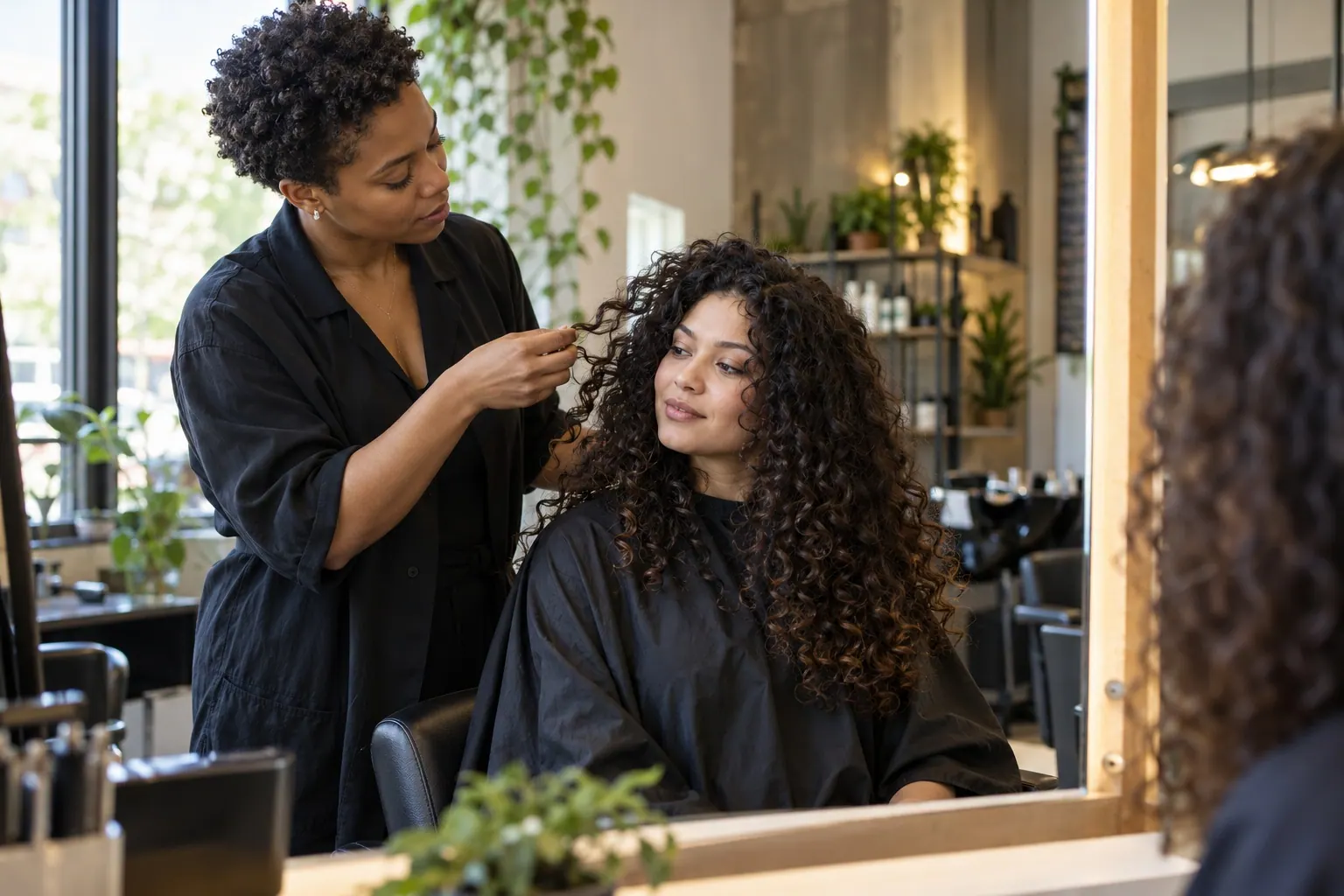
A client leaving a color, curl, or styling appointment may ask what to use at home. If the stylist has a product that fits the service, a retail recommendation can make the aftercare easier to explain and give the salon a new revenue stream. The opportunity depends on the product and the client; it does not follow automatically from the appointment or the stylist’s expertise.
The practical question is how to test the idea without turning the salon into a warehouse or making claims the formula cannot support.
What on-demand private label offers
Selfnamed’s current public pages list hair care among its product categories, describe more than 200 ready-to-brand products across the catalog, and offer dropshipping and bulk ordering. The site also describes Free and Pro plans and fulfillment in the United States and Europe. Those are platform statements, not proof that a particular hair product is available for every account or destination. Before planning a line, open the exact SKU, check its ingredients and label, confirm the fulfillment route and delivery estimate, and review current account pricing and terms. (Selfnamed: How it works; Selfnamed product catalog; Selfnamed fulfillment and shipping)
Dropshipping can reduce the need to buy and store an assortment in advance. It can also bring higher per-item costs and less control over fulfillment time and packaging. Bulk ordering can lower the unit cost while requiring more cash, storage, and responsibility for unsold products. The right choice depends on the SKU, channel, and actual order pattern—not on a broad promise of “low risk.” (Selfnamed: How it works)
A platform’s plan price, discounts, and fulfillment offer can change. Compare the total cost of the exact order in the current account, including product, label, shipping, taxes, payment charges, monthly plan, and any returns or replacement costs. Treat the platform’s advertised savings as a prompt to verify eligibility, not as a margin forecast.
Build around services, not a fixed five-slot template
A salon does not need five products simply because a framework says five. Start with one or two services that generate recurring aftercare questions. For each service, ask what the client needs to maintain at home, which product format could serve that need, and whether the supplier’s exact formula and instructions fit the intended use.
A color service might prompt a conversation about cleansing and conditioning; a curl service may create different needs around cleansing, moisture, or styling. These are questions to investigate with the client and product documentation, not claims that a particular formula protects color, repairs hair, or works for every texture. Match the recommendation to the product label and the client’s preferences.

For each candidate, keep a short product record:
- the salon service and client question it is meant to address;
- the exact product, ingredients, instructions, and destination markets;
- the claims supported by the label and evidence;
- landed cost, selling price, and fulfillment estimate;
- the reason it fits alongside the products the salon already recommends.
Order and inspect candidate products before launch. Assess the package, scent, texture, instructions, label, and order process. That practical review does not establish clinical effectiveness. If clients give feedback, explain what it will be used for, avoid pressure during treatment, and do not present a single person’s reaction as proof of a general result.
Keep scalp claims in the right category
“Scalp care” can refer to ordinary cleansing or to treatment of a condition. In the United States, FDA explains that an anti-dandruff shampoo can be both a cosmetic, because it cleanses hair, and a drug, because it is intended to treat dandruff. Products marketed for dandruff control must meet the applicable over-the-counter drug requirements; the FDA’s OTC monograph M032 covers products for dandruff, seborrheic dermatitis, and psoriasis. Do not borrow therapeutic language for a cosmetic product without verifying its regulatory status and obligations. (FDA: Is It a Cosmetic, a Drug, or Both?; FDA OTC Monograph M032)
For the European Union, cosmetic claims are subject to common criteria that include truthfulness and evidential support under Commission Regulation (EU) No 655/2013. Other markets have their own rules. A platform’s regulatory support does not by itself settle who is responsible for a label, product file, safety substantiation, or local listing. Confirm those responsibilities for the exact product and market before selling. (European Commission: Regulation 655/2013; FDA: MoCRA)
Health and performance claims also need evidence before they appear in advertising. The FTC says marketers must have adequate substantiation for objective express and implied claims; health-related claims generally require competent and reliable scientific evidence. That includes the overall impression created by product names, testimonials, photos, and copy. (FTC Health Products Compliance Guidance)
When the salon owns the brand or earns a commission, tell the client clearly before the purchase decision. In the United States, FTC endorsement guidance says material connections should be disclosed clearly and conspicuously. The appropriate wording and placement depend on the context, and other countries may impose additional requirements. (FTC Endorsement Guides: What People Are Asking)
Measure reorders instead of assuming them
Hair-care products are consumables, but consumption does not establish a reliable reorder interval. Household size, hair length, product use, price, and formula all affect how long an item lasts. Track actual orders by SKU and customer cohort. Record the time between purchases, cancellations, refunds, and the number of clients eligible to reorder. A reorder rate without a time window or denominator can make a small sample look more certain than it is.
A salon appointment can create a natural opportunity to ask whether a product is running low, but the conversation should remain optional. For online orders, use consented messages and respect the rules for the market and channel. Do not promise a recurring purchase pattern until the salon has observed one.

Calculate contribution with consistent assumptions
Before setting a retail price, estimate the contribution from each order:
Contribution = customer revenue − product cost − shipping paid by the salon − payment fees − expected refunds or replacements − sales commission − other variable selling costs.
Then account separately for fixed costs and labor. If the salon pays staff commission on retail, include it. If the customer pays shipping, record that consistently; do not count the same charge as both revenue and a cost.
For illustration only, suppose a product sells for $28. Assume product cost of $7.50, seller-paid shipping of $3.00, a hypothetical 3% payment fee ($0.84), a hypothetical 2% refund allowance ($0.56), and a hypothetical 10% sales commission ($2.80). The estimated contribution is $13.30 before fixed costs, taxes, and labor. These figures are examples, not current Selfnamed prices or recommended salon benchmarks. Replace every input with current quotes and observed costs.
Test bundles as their own order type: a pair can change the item cost, shipping tier, discount, and return exposure. A bundle that looks profitable before fulfillment may not remain so after all costs are counted.
A launch plan with six checkpoints
A cautious launch has clear checkpoints:
- Select the service. Write down the aftercare question and the client group it concerns.
- Verify the product. Review the exact SKU, formula information, claims, label, market availability, and written platform terms.
- Inspect the operation. Order a unit at full cost, time the fulfillment process, and draft a customer-support and returns plan.
- Set the economics. Use current product and shipping quotes; include fees, commissions, refunds, taxes, and owner time.
- Offer it transparently. Explain brand ownership and let the client decline without pressure.
- Review actual results. Compare contribution, delivery issues, client feedback, and reorders by SKU before expanding.
Keep the range small until the evidence supports another product. Remove any item that does not fit a real service, depends on a claim the salon cannot substantiate, or consumes more support time than its contribution can justify.
Build from the questions that return after appointments
Listen for the same aftercare question across appointments, then choose one product that matches its label and your professional scope. Review its contribution, delivery, and client response over a defined period. A smaller salon shelf can improve the service when clients understand the option and remain free to choose.