A spa’s catalog can be much larger than the range its team can explain well. More options can add training, claim review, display, and reorder work. A focused assortment makes those responsibilities easier to see, but the number alone does not predict sales. The right size depends on the services, client questions, product evidence, and staff capacity of the business.
Give each position a job
Treat three to five as a first-pass limit for candidate products. Start with one item that clearly fits an existing service. Add another only when it addresses a different client need or serves a different step in the routine. A short list might include a cleanser, a moisturizer, and one additional product the spa can explain within its expertise. A bundle can combine items that already make sense together; it does not need to count as a new product position.
For every candidate, write a one-sentence job description: “This product is here because…” If the sentence only repeats a supplier’s slogan, or if two items have the same job, remove one from the test. The aim is not to fill five slots. It is to make each recommendation easy to understand and compare.
The current Selfnamed catalog advertises more than 200 ready-to-brand products and includes skincare categories for different uses. That breadth can help with discovery, but a catalog total says nothing about what belongs in a particular spa. Verify the exact product, format, ingredients, label, fulfillment destination, and account terms before selecting it. (Selfnamed product catalog; Selfnamed: How it works)
Use a simple selection scorecard
A candidate should answer four questions before it goes into a launch test:
- Service fit: Which existing service or client question does it connect to?
- Evidence and scope: What claims are supported for this exact formula, and are they within the spa’s professional scope?
- Operational fit: Can the team explain usage, price, fulfillment, and returns without improvising?
- Economic fit: After product cost, shipping, fees, commission, refunds, and labor, does the order make sense?
If a candidate fails one of these checks, do not keep it because the packaging looks good or the supplier’s catalog is large. Record what is missing and revisit the product only when the gap is resolved.
Product language deserves particular care. In the United States, FDA explains that intended use and claims can affect whether a product is a cosmetic, a drug, or both. FDA also says cosmetic claims should be truthful and not misleading, and the person named on a cosmetic label can have responsibilities under MoCRA, including maintaining safety-substantiation records. In the European Union, Regulation 655/2013 sets common criteria for cosmetic claims, including truthfulness and evidential support. Check the rules and responsible party for each market; platform support does not settle every obligation. (FDA: Is It a Cosmetic, a Drug, or Both?; FDA: MoCRA; European Commission: Regulation 655/2013)
A spa that owns the brand should say so when it recommends the product. The FTC’s U.S. endorsement guidance calls for clear and conspicuous disclosure of material connections. A product’s image, name, or testimonial can also imply benefits beyond the literal wording, so review the whole presentation rather than one sentence in isolation. (FTC Endorsement Guides; FTC Health Products Compliance Guidance)
Price the order, not the bundle idea
A bundle can simplify a recommendation or gift purchase, but a discount reduces the amount kept on each order. Fulfillment, shipping, returns, and payment fees may also change when several items ship together. Calculate a bundle as its own order type instead of assuming it increases average order value or profit.
Use a consistent contribution formula:
Contribution per order = customer revenue − product cost − seller-paid shipping − payment fees − expected refunds or replacements − sales commission − other variable costs.
Then subtract fixed costs and the owner’s time. For a spa retail item, a staff commission is a real selling cost if the salon pays one. For a private-label product sold through a platform, use the current quote and checkout total; prices, discounts, product availability, and shipping terms can change. Selfnamed’s public pages describe dropshipping and bulk options with different cash and fulfillment trade-offs, so check the exact item and account before comparing them. (Selfnamed: How it works; Selfnamed: Fulfillment and shipping)
Decide what stays after the test
Before offering an item, choose the period and evidence you will use to review it. That period should fit the spa’s appointment cadence and the product’s likely use; there is no universal 90-day rule. Track, by SKU:
- the number of eligible service appointments;
- product recommendations and orders, using a consistent denominator;
- contribution after variable costs;
- returns, delivery problems, and support time;
- reorders within a defined time window.
Do not read a small number of early sales as proof of a stable pattern. Compare results across a meaningful number of relevant appointments and note when the sample is too small to draw a conclusion. If the item does not earn a distinct role or creates disproportionate support work, pause it and document why.
When the range should grow
Add a product only when it fills a job that the current assortment cannot do, fits the services and client questions the spa actually encounters, and passes the same evidence, operations, and cost checks as the existing items. A request from one client may be worth investigating; it is not, by itself, proof of demand across the whole client base.
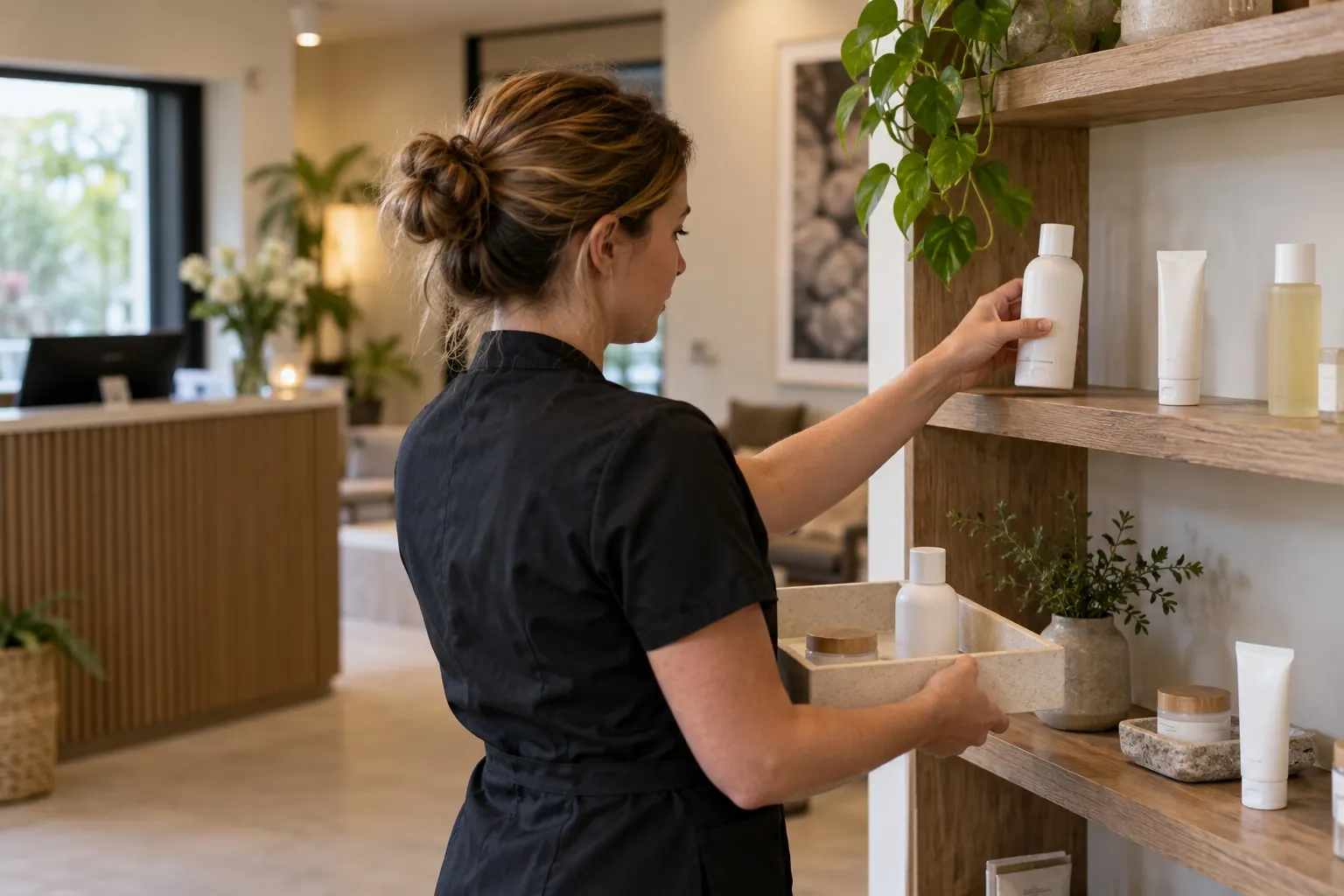
An empty position is an acceptable outcome. A short shelf can be clearer and easier to maintain than a complete-looking wall. The range should grow when the business has a specific reason and the capacity to support another item—not because a platform’s catalog makes it possible.