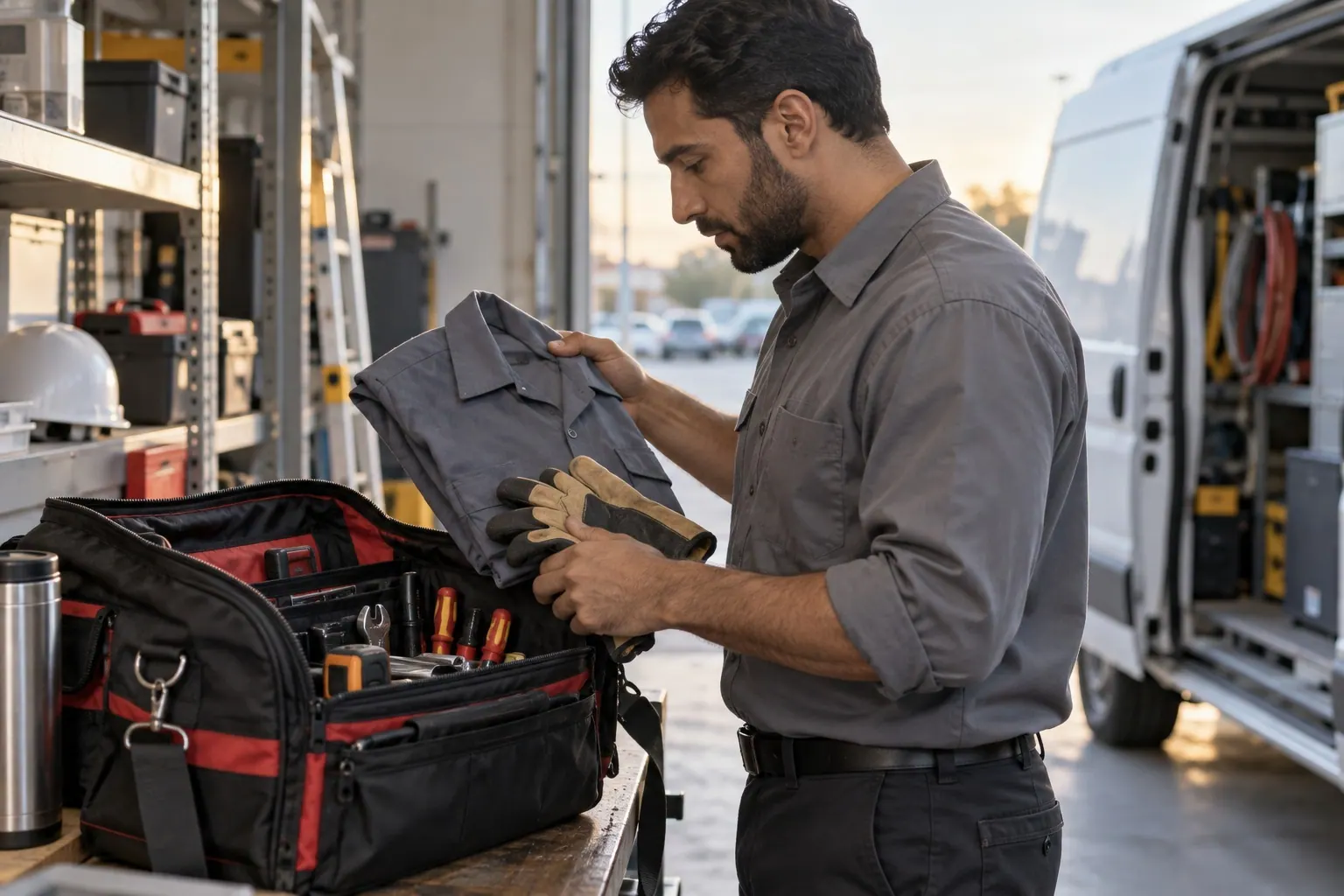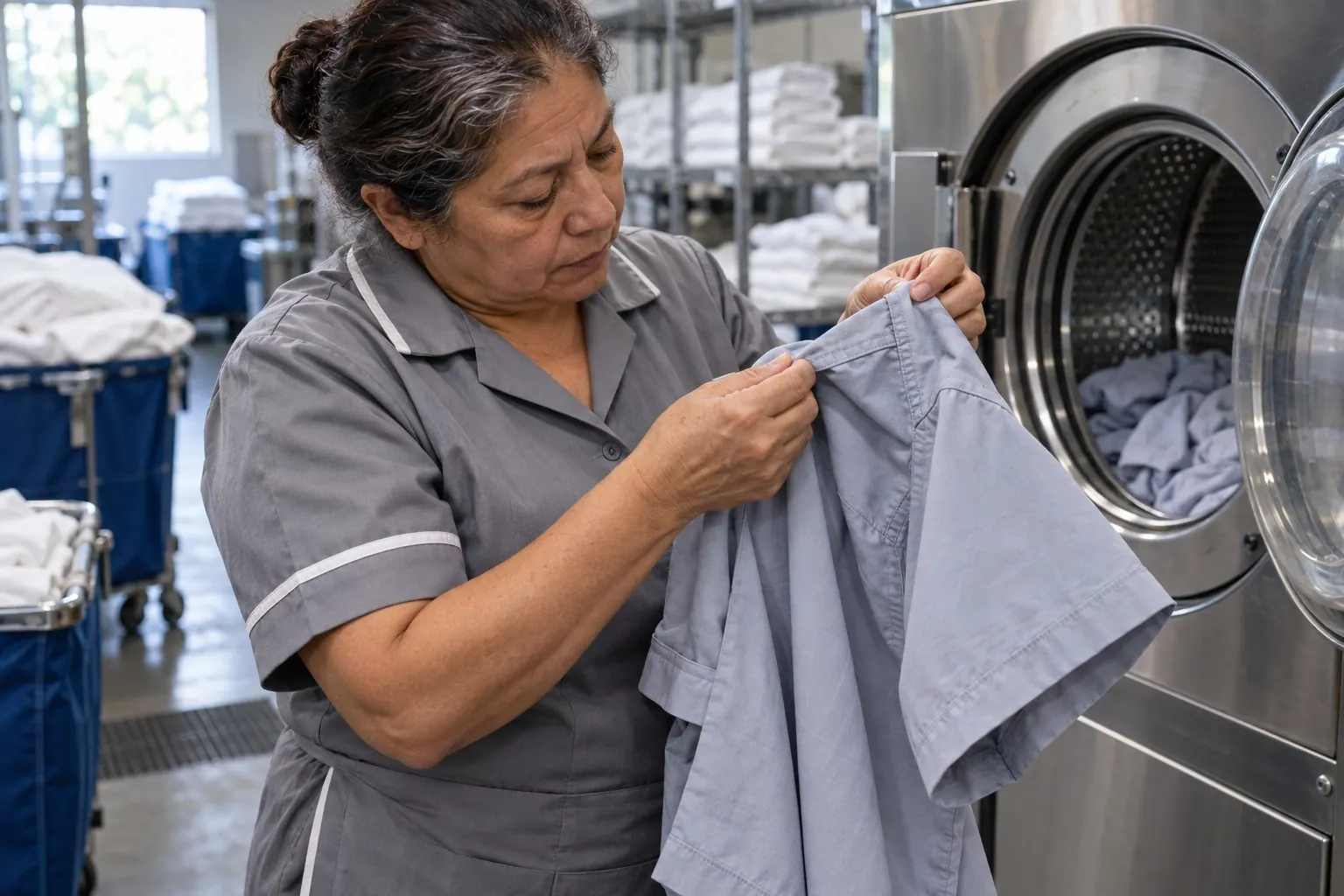
A facilities company that washes one uniform after every shift can put very different demands on a garment than an office that washes a polo once a week. Five shifts a week across fifty working weeks would mean 250 washes in a year. That is scenario arithmetic, not an industry average and not a prediction of garment life.
Begin with the company’s actual care process and the work each garment must tolerate. A cleaning team, a property-maintenance crew, and a client-facing facilities manager may share one brand while needing different clothes, wash routines, and checks.
Start with the care process
Write down how each role’s garments are washed: who launders them, how often, which detergent is used, whether bleach is permitted, what water temperature is used, and how the garments are dried. The goal is not to prescribe a universal laundry routine. It is to see whether the product’s published care instructions fit the one the company actually uses.
A Yoycol men’s AOP polo provides a concrete example. The product page lists a composition of 88% polyester and 12% spandex, a fabric weight of 210 g/m², and care instructions to machine-wash cold with similar colors, avoid bleach, tumble-dry low, and not iron or dry-clean. Those details help define a shortlist. They do not establish suitability for industrial laundering, retained color, or service life.
If an operation requires a process that conflicts with the published label, do not assume the garment will tolerate it because the fiber blend sounds appropriate. Ask the supplier for product-specific evidence or test a sample under the proposed process. Record the result as a limited test of that SKU and process—not proof that every size, production batch, or future garment will behave the same way.
Do not turn fiber percentages into a durability ranking
Fiber composition can describe a product. It cannot, by itself, tell a buyer which garment will last longer. Two polyester-spandex garments with different elastane percentages can also differ in construction, yarn, seams, finishing, fit, and use. Without comparative testing, a 12% elastane polo cannot be said to outlast a 20% skort.
The same restraint applies to comfort, drying speed, print retention, and shrinkage. These properties depend on construction and conditions. Treat catalogue claims as product descriptions, not as observed results from a cleaning crew.
Research has found higher post-exercise malodor in polyester shirts than in cotton shirts under a specific study design. That is a relevant question for close-contact, sweat-heavy work, but it does not establish what a particular Yoycol garment will smell like after a particular commercial wash. Wearer feedback and a real-use trial are needed before making that claim about a uniform program. Callewaert et al., “Microbial Odor Profile of Polyester and Cotton Clothes after a Fitness Session”.
Test the work and the wash
Order samples in the sizes that matter to the roster. Inspect print placement, seams, fit, opacity, movement, and whether the garment stays in place while staff reach, kneel, carry equipment, or work overhead. Check the care instructions before testing; a trial that knowingly departs from them should be recorded as an exception, with the buyer’s acceptance documented.

A short wash trial can catch early problems such as unexpected shrinkage, print changes, seam issues, or fit changes. Twenty cycles are a screening sample, not evidence of a full year of service. If the company proceeds, record failures and replacements over time. That operating history is more useful than a generic lifespan estimate.
The trial also needs a fair comparison. Wash candidate garments under the same documented conditions. If different roles use different processes, test those conditions separately. Keep photographs, dates, product identifiers, size, wash settings, and observations so the buyer can distinguish a product issue from a process change.
Model replacement economics without inventing a service life
A rotation plan changes how many garments must be purchased at the start. It does not prove that each garment will last longer. Compare a few explicit scenarios using the company’s own data:
- initial garment quantity per employee;
- average weekly wear and wash frequency;
- replacement rate observed during a pilot;
- unit price at the live quantity tier;
- shipping, branding, sample, tax, and handling costs;
- the administrative cost of small replacement orders.
For example, a 20-person team receiving three garments each would need 60 pieces initially. Confirm the live per-unit rate for that quantity in the cart, then add shipping, branding, taxes, samples, and handling before preparing a proposal. A displayed single-unit price is not the landed cost. (Yoycol — Shipping steps, live rates, and delivery estimates)
A consolidated order may reduce the average freight cost per unit, but the amount depends on product, destination, and shipping method. Use the live quote rather than extrapolating from a different garment’s example. A small reserve stock may help a company with frequent hiring or urgent replacements; size distribution, storage, and actual hiring data should determine how much.
Keep branding separate from safety
A consistent uniform can help clients identify staff and may support a professional presentation. Whether it changes a buyer’s perception or a contract’s economics is a question for the company’s own client evidence.
Yoycol’s all-over-print format can support a coordinated visual system, but full-garment coverage is a design option, not a requirement. The product page also lists branding services on eligible items; confirm SKU eligibility, placement, cost, and lead time before including them in a proposal.
A printed garment is not certified high-visibility clothing or protective equipment. Where traffic, chemicals, heat, electrical hazards, or another task risk requires protective clothing, use products documented for the applicable requirement. A bright color or a product name is not a substitute for that evidence.
A procurement sequence for facility-services teams
- Separate roles by environment, movement, client contact, and safety requirement.
- Document the laundering process used for each role.
- Compare live product care instructions and remove incompatible candidates.
- Order and inspect samples in roster-relevant sizes.
- Test movement and a limited number of documented wash cycles.
- Run a pilot and track fit, failures, replacements, and wearer feedback.
- Build landed-cost scenarios from live product tiers and shipping quotes.
- Revisit the choice when the process, SKU, workforce, or evidence changes.

The central decision is not whether polyester or cotton wins in the abstract. It is whether a specific garment meets the company’s documented work and care requirements at a cost the buyer can support. Catalogue specifications can narrow the shortlist. A sample, a controlled pilot, and the client’s own operating data must carry the final decision.