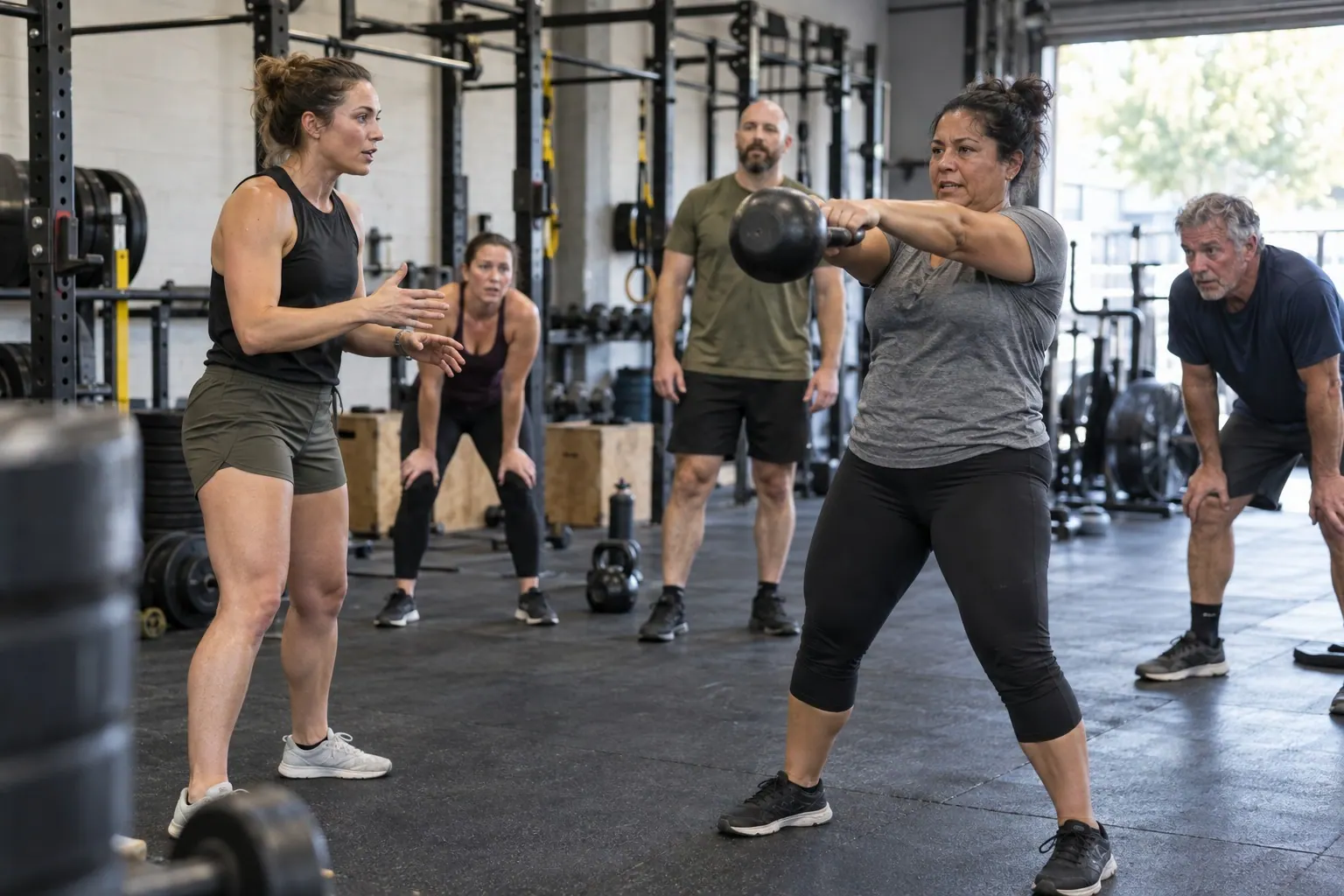
A coach’s product line has a particular context: the people who may buy it also see the coach teach, train, and support a group. That closeness can make a shirt or hoodie feel meaningful. It also makes accuracy important. If a garment is described as training equipment, customers may expect it to perform during a workout. If it is a team shirt or post-session layer, say that clearly.
Fourthwall provides an online storefront and a catalog of products that can be customized and fulfilled on demand. The catalog can help a coach test a small offer without ordering a large batch in advance. It does not show that clients will buy a particular design, nor does a listed apparel item automatically meet the demands of a specific sport or training session.
Set the product’s role in the gym community first, then identify the evidence needed to describe it honestly.
Decide what the product is for
A coach might offer a shirt to identify a training group, a hoodie for travel to and from the gym, or an item that marks completion of a program. Those are possible uses, not proven demand. Before selecting a blank, answer four practical questions:
- Who is the item for: current clients, online followers, or a wider audience?
- When would they wear or use it: in a session, before or after training, or in daily life?
- What does the product need to do, and which product details support that claim?
- What price and size range fit the people you intend to serve?
These answers help determine whether the offer is apparel, a training aid, a recognition item, or a combination. Avoid building a large catalog before you know what choice each product adds.
Use the catalog as a shortlist
Fourthwall’s live catalog includes apparel and accessories. Product details vary by listing, so compare the exact item’s material, weight, fit, sizes, colors, print method, print areas, fulfillment regions, and current cost. A single product page is not a promise about every tee or hoodie in the catalog.
For example, Fourthwall currently lists the Gildan 64000 Softstyle T-shirt from $9.50, with no minimum order and fulfillment from several regions including the US, EU, UK, Australia, Japan, Canada, and Brazil. Its page lists solid-color fabric as 100% ring-spun cotton, while Heather and Sport Grey have different fiber compositions. The Comfort Colors 1567 hoodie is listed from $39.95, in an 80% ring-spun cotton and 20% polyester blend, with 9.5 oz heavyweight fabric and no minimum. These are snapshots of two current listings, not endorsements or a universal comparison of product quality. Verify the live page, color, size, and destination before using its details. (Gildan 64000 listing; Comfort Colors 1567 hoodie listing)
A listing’s base cost is also not its selling price or the full cost of a sale. Shipping, processing, samples, design, promotion, taxes, and other expenses may affect the result. Write those details down while you compare products instead of deciding from a product name or a thumbnail.
Separate identity apparel from performance gear
Gym clothing can be meaningful without claiming technical performance. A group tee, a hoodie, or an embroidered cap can express a training community. A product marketed as squat-proof, moisture-wicking, compression, or suitable for intense training makes a more specific claim that needs support from the garment specifications and testing.
A catalog page may tell you the fiber blend and fabric weight but leave out properties such as opacity under stretch, moisture management, seam comfort during repeated movement, or waistband stability. Do not infer those qualities from a percentage of elastane or a product category. If performance is part of the product promise, order a sample and evaluate the actual item under the conditions you plan to describe. One sample is useful evidence about that sample; it is not a guarantee across every size, color, or production run.
When you do not have the evidence, describe the product according to what you know: for example, a printed tee for gym or everyday wear. Do not call it performance apparel solely because it appears beside activewear in a catalog.
Fourthwall offers samples at manufacturing cost. Its help center recommends checking fit, fabric, print quality, and placement before selling, and notes that samples follow production and shipping timelines. A sample can reveal whether the product fits the community brief and whether your store images need to change. (Fourthwall sample-order guidance)
Give each product a clear role
A small launch might use one accessible shirt and one layer for cooler travel or warmups. Another gym might need only one product that marks a cohort or training milestone. These are examples to adapt, not a formula for assortment size.
| Possible product role | What it can communicate | What to check |
|---|---|---|
| Team or cohort shirt | Shared participation or a group identity | Fit, size range, fabric, print method, and order timing |
| Post-training layer | Comfort before or after a session | Weight, material, fit, care instructions, and sample |
| Accessory | A visual marker or practical everyday item | Dimensions, material, printing or embroidery options, and cost |
Tie design to a real feature of your coaching: a phrase clients recognize, a training block’s name, or a visual detail connected to the gym. Keep private client details out of public artwork unless you have permission. A logo can be one part of the design; it does not need to be the entire concept.
Price with the complete transaction in view
Fourthwall’s pricing page says catalog products have a listed flat product cost and that US-based card transactions incur a separate 2.9% plus $0.30 processing fee. Here is a transparent illustration, before shipping paid by the creator, taxes, samples, design, promotion, refunds, and other costs:
- A Gildan 64000 listed from $9.50, sold for $22: $22 − $9.50 − $0.94 processing = about $11.56 in contribution before other costs.
- A Comfort Colors 1567 hoodie listed from $39.95, sold for $68: $68 − $39.95 − $2.27 processing = about $25.78 in contribution before other costs.
This is not a forecast of sales or profit. The exact product cost can vary by size or other listing details; confirm the amount shown for the selected variant and order destination. The full route also includes the work of designing, presenting, and supporting the product. (Fourthwall pricing and fees)
Make the price legible to clients. Describe the item and what they will receive, rather than relying on a “premium” label. If you offer a product as a gift or program completion item, budget it as a business expense instead of counting its full retail price as revenue.
Memberships are a separate offer
Fourthwall memberships can support paid content or community access. The current pricing page lists a 5% platform fee for memberships on both Free and Pro, with payment processing also applying. Its help center says creators can make certain products available only to members or offer members-only promotions. These are platform features; they do not show that every coaching business needs a membership or that clients will pay for one. (Fourthwall plans and pricing; Memberships FAQ)
If you offer a membership, define the value independently of merchandise: for example, the coaching material, access, or interaction the member receives. A product can be an optional perk or an occasional release. Keep the terms clear, and do not imply that buying apparel is required to belong to a training group unless that is genuinely the arrangement.
Put community apparel and training gear through different tests
A coach considering a first item can start with a shirt whose purpose is to identify the training community. That offer needs an accurate listing, a sample check for fit and print, and a price based on the full transaction. A garment presented as functional training gear needs a separate product-specific test: verify the material and care information, then check the sample under the movements and conditions the description names. A sample that fits well does not establish moisture control, durability, or injury prevention.
This distinction also clarifies the next decision. If the product is about community, refine the design and offer from actual orders and customer feedback. If its value depends on performance, keep testing until the claims are supported or describe the item more narrowly. A membership can sit alongside either offer, but its content, cadence, and economics should stand on their own.
A good coach-led product line does not need to imitate a sportswear company. It can reflect a real group, a shared goal, or the culture of a gym. Make the item’s role clear, describe it accurately, and check that the economics work before inviting clients to buy.