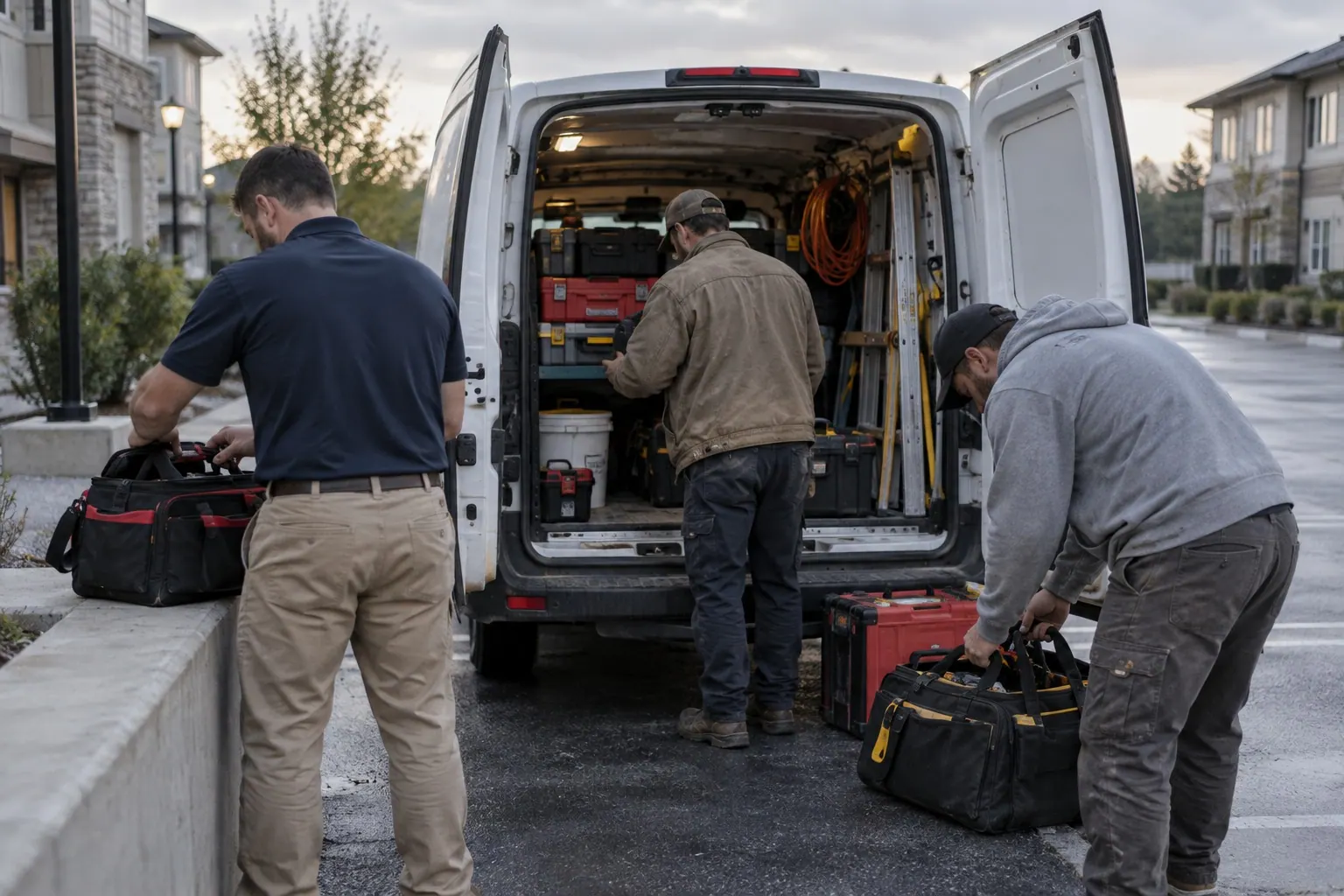
A service company may list several towns on its website and still operate from one crew. Another may have multiple branches whose websites and purchasing decisions are controlled by a parent company. A third may be a franchise where the local operator has limited say over uniforms, signage, or marketing.
Those differences matter more to a freelancer than the number of city names in a footer. A multi-location footprint can suggest a coordination question; it does not establish growth, budget, inconsistency, or demand for design work. Before proposing a standardization project, learn how the business actually operates and who can approve a change.
This guide uses public research to prepare that conversation, then shows how to turn confirmed needs into a bounded scope. The examples are hypothetical, not observations of a named company or client result.
A location page is a clue, not a count
A page titled “Locations” may list staffed branches, service areas, franchise territories, or towns a company hopes to reach. A service-area page may not represent an office at all. A location can be out of date, duplicated across a template, or managed by a franchisor.
Start with a specific question: does the company currently serve or operate in more than one place, and how does it represent those places? Search can help find relevant public pages:
site:example.com locations
site:example.com branches
site:example.com “service area”
Google documents the site: operator as a way to narrow results to a domain or URL prefix, while noting that results are not exhaustive. A search result does not enumerate every page. Open the business’s own current site and verify the locations it presents; if the distinction matters to your offer, ask the company whether those entries are staffed branches, service areas, or something else. (Google Search Help — Refine Google searches)
You can also use Google Maps to check whether a claimed address appears as a business location. Treat the result as another clue that needs current verification. Do not copy Maps content or photos into a pitch, mass-download results, or automate queries. Google Maps terms limit copying subject to permissions and applicable law and prohibit mass downloads or bulk feeds. Google’s Search policies also describe automated queries without express permission as machine-generated traffic that violates its spam policies and Terms of Service.
Find out who controls the decision
The public brand may be shared while authority is not. Before you pitch a central system, identify which level can approve the work:
- Company-owned branches: a central owner or operations team may set the standard, with local managers giving input.
- Franchise locations: the franchisor may control identity and approved suppliers; a franchisee may be able to choose only within those rules.
- Independent operators under one name: branches may share a public identity but have different owners or purchasing arrangements.
- Service-area businesses: several listed towns may be served by one team, without branch-level operations.
- Partner or dealer networks: local businesses may use a shared brand under a license or agreement.
These are questions to verify, not categories to infer from web design. A page per city does not prove that each location has a separate manager or budget. A uniform logo across multiple pages does not prove the company has a formal brand guide.
The first useful research record is modest: the official page where the locations are described, the date checked, the apparent business structure, what remains uncertain, and the question to ask. Keep it focused on the company. Do not estimate revenue, staff size, expansion budget, or purchasing authority from the number of pages, reviews, or photographs.
Separate shared elements from local needs
A standardization project can mean many things: one template for proposals, a common signage system, consistent workwear, an updated location page, or a shared process for local promotions. Do not bundle them into a “brand system” until the buyer confirms what is inconsistent and what should remain flexible.
In discovery, ask:
- Which decisions are currently made centrally, and which are local?
- What needs to look or work the same across locations?
- Where does a branch need room to adapt?
- Who uses the materials, and who approves the final version?
- Are there existing brand, franchise, supplier, or procurement rules?
- What has already been tried, and what made it difficult?
- Is there an active project or a date that makes a change relevant now?
A standard should reduce a real coordination problem without making local work harder. The owner may value a common identity but want each branch to choose its own suppliers. A franchisor may already provide signage and templates. A business might want a shared proposal document but have no interest in changing uniforms. The scope follows the answer.

Keep workwear design separate from safety decisions
Workwear can make a team recognizable and help a business present consistently. Protective equipment is a different responsibility. For employees covered by OSHA’s general-industry PPE rule, 29 CFR § 1910.132 requires employers to assess workplace hazards, select PPE that addresses the identified hazards, and select PPE that properly fits each affected employee (OSHA standard). Construction has a separate PPE standard, so the employer’s safety lead should confirm which requirements apply. A freelancer should not specify protective equipment from a website photo or use a branding brief as a substitute for the employer’s hazard assessment. (U.S. Department of Labor — OSHA Fact Sheet: Personal Protective Equipment)
If the confirmed project involves protective garments, ask the employer to provide approved requirements and involve the qualified people responsible for workplace safety. Keep the design scope to branding and production files that follow those approved specifications. Requirements outside the United States can differ, and the responsible employer or safety professional must confirm them.
The same boundary applies to supplier claims. A mockup is not proof of fabric performance, durability, fit, or production readiness. State what you prepared, which supplier specifications it follows, and what the client or manufacturer still needs to verify.
Build the scope around one confirmed job
After the company confirms a need and identifies the decision-maker, translate the problem into an offer. A small first phase might document existing approved assets and map how they are used across locations. A later phase could create a shared toolkit with local variants. Possible deliverables include:
- an agreed inventory of assets and applications supplied by the client;
- a core template or design system for items the client chooses;
- permitted location-specific fields, such as local contact details or service lists;
- production-ready files prepared to the selected supplier’s requirements; and
- a handoff guide stating who can use, edit, approve, and reorder the materials.

Those elements are options, not a ready-made package for every operator. Confirm rights to logos, fonts, photographs, and other supplied assets. Name the person responsible for approvals. Separate design from printing, installation, sourcing, safety review, and profile management unless they are in scope and within your expertise.
A good proposal also records assumptions and dependencies. If a central brand guide or vendor specification is missing, say so. If each branch requires a different adaptation, describe the additional work before quoting. A standardization system does not guarantee that every location will adopt it or that the company will gain customers.
Price the real rollout, not the location count
A setup fee plus local adaptation can be a useful pricing structure when the first piece creates a shared system and each branch needs additional work. It is not automatically fair or accurate to charge a fixed amount per address. Some locations may need no adaptation; others may require new materials, approvals, translation, or production coordination.
Estimate effort from the agreed deliverables, number and type of adaptations, revision rounds, rights, client inputs, supplier coordination, timing, and your capacity. A pilot at one location can be appropriate if the client wants to test usability before wider rollout, but it should not be portrayed as proof of market demand. Document who pays production costs and how changes to the number of locations affect scope.
Recurring work is possible when the company confirms ongoing needs—new locations, revised service information, or replacement materials—and both sides agree what will be delivered. Do not promise a retainer or future revenue based only on a growing directory.
A hypothetical example
Imagine a cleaning company whose website lists several service areas. Search and the company’s public site help a freelancer verify the names it currently presents, but they do not reveal whether the company has branches or one mobile team. The freelancer contacts the operations lead through the published business channel and asks who decides about crew apparel and how local hiring is handled.
The operations lead explains that the company has one central purchasing process and that garments must meet requirements already set by the employer. The current project is a new onboarding sheet and an approved garment mockup; a complete rebrand is not on the agenda. The freelancer can now decide whether those deliverables fit their service, confirm who approves them, request the relevant specifications, and quote that scope.
If the contact instead says the locations are franchise territories with brand rules owned by headquarters, the next step is to ask whether headquarters is the right contact. If the team has no project or need, the freelancer closes the lead. None of these outcomes can be read from the count of location pages.
An outreach note that leaves room for correction
A first message should state what you verified and invite the recipient to correct your understanding:
Hello [Name], I found the locations page on [Company]’s website while learning how multi-location service businesses manage [specific area]. I’m not sure whether these are staffed branches or service areas. Is there someone responsible for [the project you can actually deliver] whom I could ask about the process? If this is not being reviewed, I understand.
Use only facts you checked. Do not tell a proud owner that their brand is inconsistent or that the company has outgrown its systems. Contact a business through a published channel for business inquiries, keep outreach appropriate to the recipient, and follow the privacy and direct-marketing rules that apply.

When to advance—and when to stop
Advance when the right person confirms a problem your service can address, the decision path is clear enough to scope, and the work can be delivered within your capabilities and terms. Pause when authority, requirements, or supplier constraints remain unknown. Decline work that requires you to make decisions outside your competence.
A location footprint can make a useful research question visible. It cannot tell you whether the company is ready, whether branches should be standardized, or whether you are speaking to the buyer. The valuable work is finding out how decisions are actually made and proposing only the part the client has confirmed it needs.