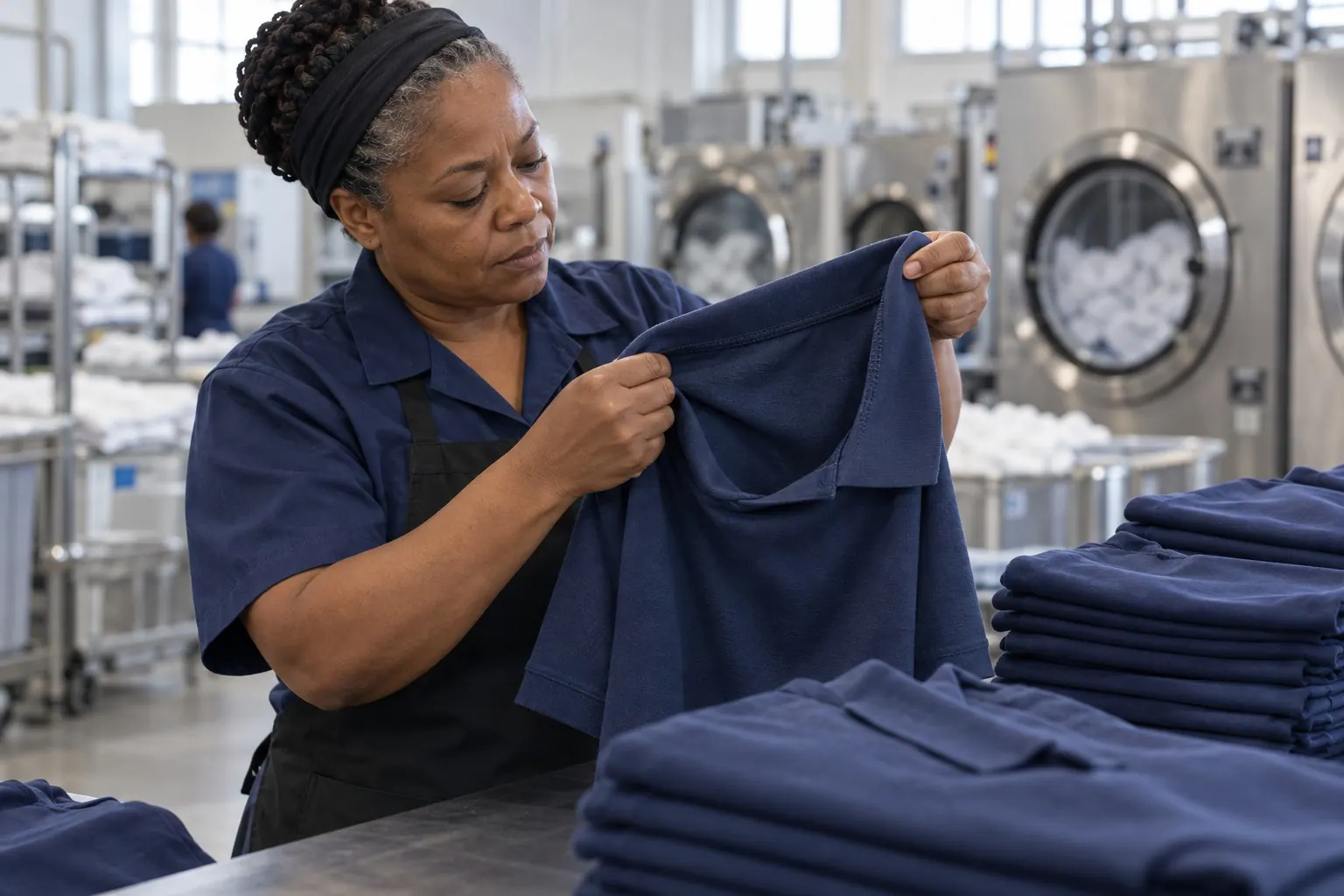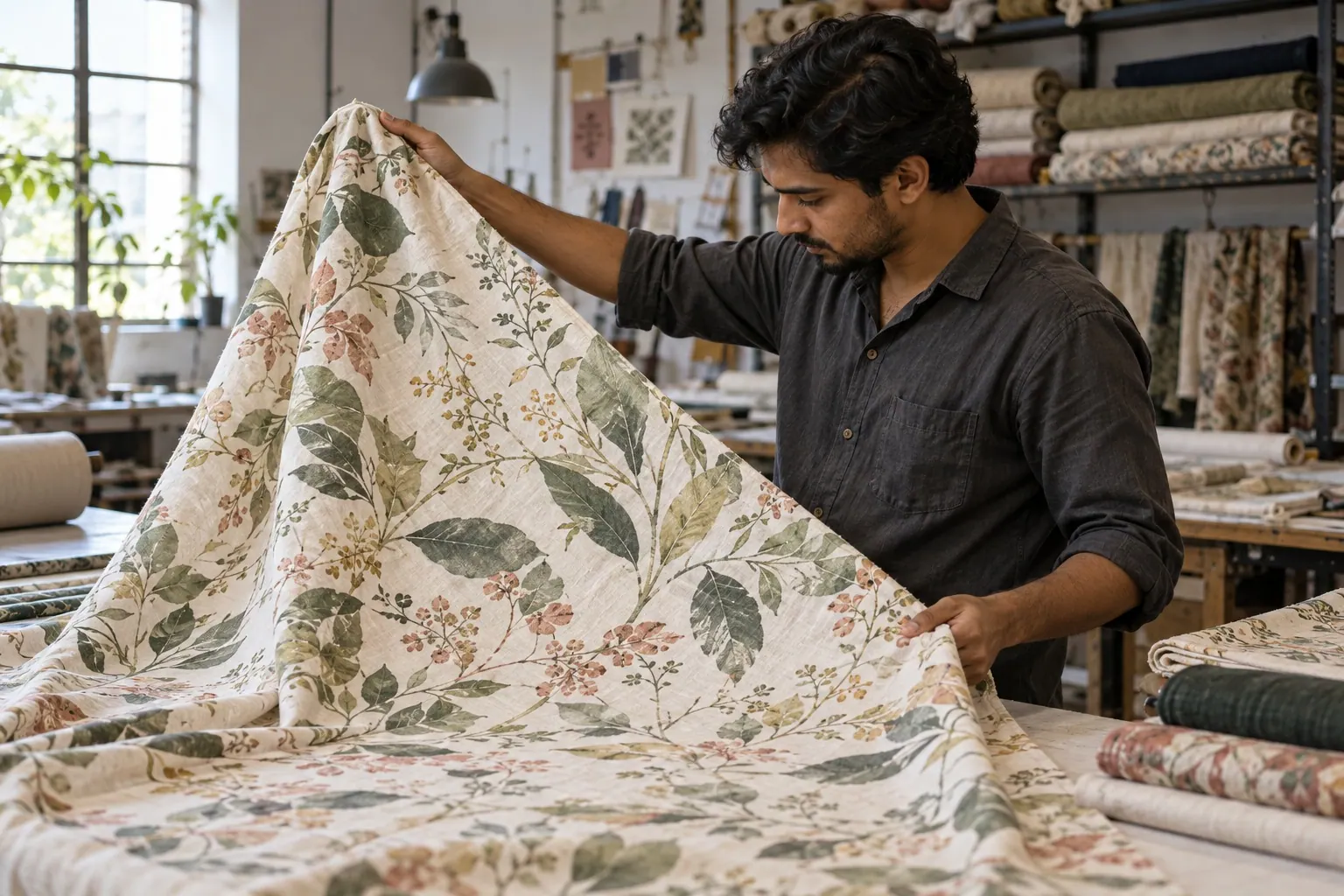
Consider an illustrative 40-person facilities-services company: hosts and office staff work indoors, cleaning crews move between client sites, two maintenance technicians split time between rooftops and crawlspaces, and managers meet clients weekly. Calling all of that “the company uniform” can hide four different jobs. Office staff need a polished appearance; cleaners need garments suited to frequent laundering; technicians need coverage and freedom of movement; managers need a client-facing look. One SKU may not serve all four roles equally well.
Print-on-demand can reduce the need to hold uniform inventory, but the buyer still has to qualify each garment for its job. A product page can show composition, care instructions, size range, and print options; it cannot establish how a sample will fit a particular team or hold up under its actual laundering routine. Ordering one item at a time may lower the cost of an initial trial, yet it makes role-by-role sampling and a clear replenishment plan more important.
This article is the framework for avoiding that outcome. It is written around Yoycol, whose specifications are verifiable at the listing level, but the method applies to any POD supplier being evaluated for B2B uniform work.
Start From the Role, Not the Catalog
The framework begins with a question the catalog cannot answer: what does each employee physically do during a shift? Four variables do most of the work:
Environment. Indoors or outdoors? Hot kitchen, air-conditioned office, rooftop in August, or a client’s marble lobby? Heat raises the value of breathable, lightweight fabrics; cold and wind push the program toward layered or heavier garments; presentation-critical environments reward structure.
Wash frequency. A kitchen garment laundered after every shift can reach 250-plus wash cycles in a 250-shift year; a manager’s polo may be washed far less often. Treat those figures as an illustrative planning model and replace them with the team’s actual schedule. Wash frequency is one of the most useful operating inputs because it changes which fabric and care properties matter more than many style preferences.
Movement. A technician reaching overhead in a crawlspace needs stretch through the shoulders and a fit that does not ride up; a host standing at a podium needs neither. Stretch content and cut follow the job’s range of motion.
Presentation requirement. How formal does the garment need to look? A structured, heavier polo reads “established company”; a soft, lightweight knit reads “practical workwear.” Neither is wrong — but mixing them across client-facing and non-facing roles wastes money in one direction and credibility in the other.
Fabric Composition: Reading the Listing Like a Textile Buyer
Yoycol’s sport and uniform-relevant listings publish composition data, and the differences between them are instructive. The men’s all-over-print polo collar jersey is listed at 88% polyester / 12% spandex. The women’s active skort with inner shorts is 80% polyester / 20% spandex. The women’s high-stretch tights run 87.5% nylon / 12.5% spandex, while the women’s yoga leggings are listed at 92% polyester / 8% spandex and a lower price point. (women’s active skort; women’s yoga leggings; women’s high-stretch tights)
What those numbers mean in practice
- Polyester-dominant blends are common in workwear and activewear. The University of Georgia Extension fiber guide describes polyester as strong and resistant to abrasion, weather, and many chemicals, while also noting that it can retain perspiration odor and melt if overheated. A controlled study of exercise garments found greater perceived malodor in the tested polyester garments than in cotton after exercise and incubation; that result does not make every polyester knit behave the same way. Fabric construction, finish, care, and the actual wearer all matter. (University of Georgia Extension fiber guide; Callewaert et al., “Microbial Odor Profile of Polyester and Cotton Clothes after a Fitness Session”)
- Higher spandex content can increase stretch, but a percentage alone does not predict fit, recovery, or service life. Follow the product’s care instructions and test a sample under the laundry conditions the team will actually use. Yoycol’s current listings for the tights and skort specify cold washing and low-temperature tumble drying.
- Nylon-spandex and polyester-spandex listings should be compared by sample, construction, care instructions, and price rather than fiber label alone. In the current listings checked for this article, the nylon-blend tights are $9.29 and the polyester-blend yoga leggings are $6.59; the difference is a product-specific price snapshot, not proof that one fiber blend is more comfortable or durable.
Note the honest limit of this analysis: composition tells you the fiber family and stretch potential. It does not tell you knit tightness, surface treatment, or construction quality. Those only a sample can reveal.

GSM and Weight: What the Numbers Mean for Occupations
GSM means grams per square meter and describes fabric mass per area; it is not a quality rating. Fabric construction also affects drape and function, so GSM alone cannot establish durability, comfort, opacity, or suitability. Some Yoycol listings omit fabric GSM, while the specific men’s polo collar jersey listing does publish 210 g/m². The ranges below are screening heuristics for choosing samples, not pass/fail thresholds; climate, construction, and task can change the result: (Cornell University guide to fabric construction and weight)
| GSM band | Screening cue | Possible uniform fit |
|---|---|---|
| ~140–160 | Lighter fabric; drape varies by construction | Consider for hot kitchens, outdoor summer work, or delivery roles |
| ~170–200 | Mid-weight starting point; feel and structure vary | Consider for cleaning crews and general service roles |
| ~210–250 | Heavier starting point; verify opacity and drape | Consider for client-facing management or hospitality |
A heavier 210–250 GSM polo may suit roles where structure and presentation matter — such as a hotel host station or corporate office — while a lighter garment may be more comfortable for outdoor service technicians in hot conditions. Confirm the choice with a sample in the actual climate and task.
Do not convert an item’s listed weight in kilograms into fabric GSM: they measure different things. For the polo collar jersey, Yoycol publishes both an item weight of 0.285 kg and a fabric weight of 210 g/m². The high-stretch tights listing gives an item weight of 0.099 kg but does not provide fabric GSM. When a supplier omits fabric weight, request the specification or compare physical samples instead of inferring it from a shipping weight or resale description.
Fit, Size Range, and the Body Distribution Problem
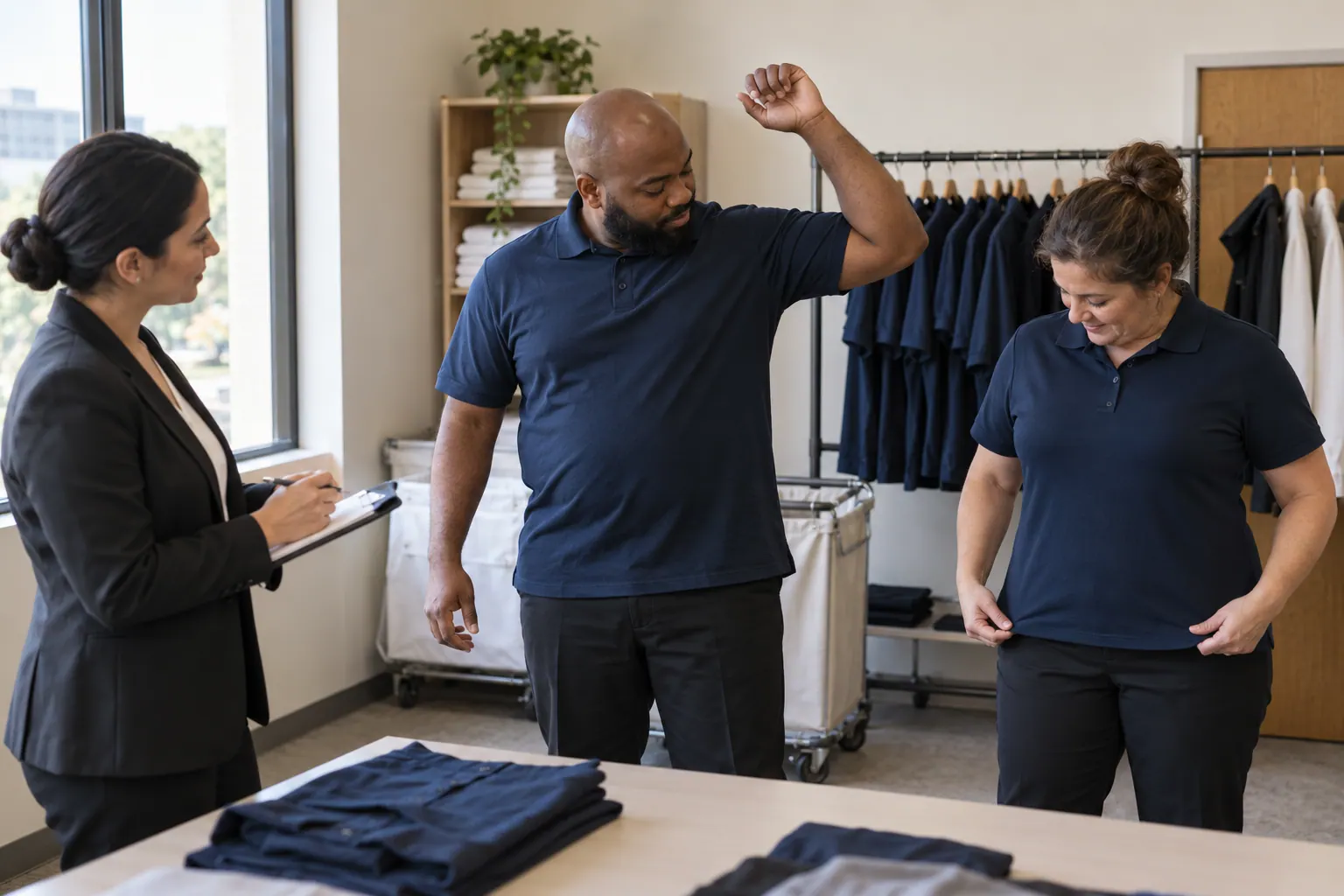
A uniform program serves the team you have, not a size curve optimized for e-commerce returns. Yoycol’s listed size ranges vary meaningfully by product: the yoga leggings run S–6XL, the high-stretch tights S–2XL, and the active skort XS–5XL. The lesson for B2B buying: size coverage is a per-product property, not a platform property. Qualify the specific garment against your actual roster — including the two employees who need the top of the range and the one who needs the bottom — before standardizing on it.
Fit evaluation requires samples in at least the boundary sizes. POD grading varies between manufacturers, and a polo that fits everyone at M can fail at both ends of the range. Do not use a category-level size range as a promise for a particular product; confirm the selected listing and size chart before quoting a uniform program.
Print Coverage, Branding, and the AOP Reality
Yoycol offers all-over-print garments, and that shapes what branding means. Full-garment print coverage allows a design to extend beyond a chest or back placement, although the exact printable areas depend on the product template. For uniforms this can support a consistent color field across a garment. Check the selected listing and design template for included print areas and price; do not assume every garment has identical coverage or branding terms.
The discipline it demands is design restraint. A uniform is part of a workday, so a design built for a merchandise launch may compete with the garment’s practical role. Consider controlled color fields, tonal patterns, or deliberate placement of the mark within the printable area, then review the actual product template before approving the artwork.
Yoycol’s current branding page lists packaging, hang tags, and neck labels, with eligibility depending on the item and fulfillment route. Published options show packaging at $0.42 per unit plus a $0.50 service fee (500-unit minimum), hang tags at $0.56 per unit plus a $0.50 service fee (500-unit minimum), and on-demand neck labels at $1 each with a one-item minimum and no service fee. Packaging and hang-tag inventory must be stocked in advance; neck labels are produced on demand. Verify the current listing and account terms before promising a branded finish. (current branding options)
Lead Times and Shipping: The Budget Nobody Prices First
Yoycol’s current public pages use different scopes for production and fulfillment. The homepage advertises fulfillment in one to five days; the Help Center defines clothes fulfillment as two to four days before shipment; and the fulfillment promise lists a two-to-four-day average and seven-day production commitment for men’s and women’s clothing. An individual polo listing gives a 4.6-day average, 5.8 days for 90% of orders, and a 10-day production guarantee. These are production and fulfillment estimates, not delivery-to-door guarantees. Yoycol says most orders are produced in China, with US and selected EU fulfillment nodes for eligible items; routing and delivery estimates depend on product and destination. Build a buffer in weeks for a uniform program and confirm the live route and order-level estimate before making a date-bound promise. (homepage; fulfillment-time FAQ; fulfillment promise; polo listing; global fulfillment)
Yoycol’s shipping-rate example lists $10.79 to ship one hoodie to the US by standard shipping and $18.43 for two, or about $9.22 per hoodie when consolidated. The page says rates are for reference and may change; this example is not a quote for another product or destination. The same cost principle can matter in a uniform program, but confirm the live quote for the selected items, destination, and shipping method. Product listings also show quantity tiers; for the polo collar jersey, the current page lists lower per-unit prices at higher order quantities. (shipping-rate example; shipping information)
The Decision Matrix
The following matrix condenses the framework into a reusable qualification sheet. The annual wash counts are illustrative assumptions; replace them with the team’s actual work and laundering schedule. Score each candidate garment per role; anything scoring low on a “must” row for that role is disqualified regardless of price.
| Criterion | Question | Hot kitchen role | Outdoor technician | Client-facing manager |
|---|---|---|---|---|
| Fabric composition | Does the blend suit heat/wash/movement? | Breathable poly blend, low-mid spandex | Poly blend, 10–12% spandex for reach | Poly blend for structure and wash stability |
| GSM / weight | Right weight band for the environment? | ~140–160 GSM or light garment weight | Light-to-mid; layering for seasons | ~210–250 GSM or heavier garment weight |
| Size coverage | Does the range cover the actual roster? | Verify per product | Verify per product | Verify per product |
| Fit and mobility | Does the cut survive the role’s range of motion? | Upper-body reach tolerance | Critical — overhead work | Presentation drape |
| Wash tolerance | Will it survive the role’s wash frequency? | 250+ cycles/year — the binding constraint | 50–100 cycles/year | 25–50 cycles/year |
| Branding fit | Neck labels, packing, AOP restraint available? | Interior label + durable exterior identity | High-visibility branding on the garment | Subtle, structured brand presentation |
| Lead time fit | Can ordering rhythm absorb production + transit? | Buffer for reopening dates | Seasonal pre-order | Onboarding lead time |
| Unit economics | Product + tiered pricing + consolidated shipping? | Batch with kitchen stock | Batch by crew | Batch with management set |
Three roles, three different constraints: the kitchen garment is judged by wash tolerance, the technician’s by coverage and mobility, and the manager’s by presentation. Standardizing the whole team on the garment preferred by the person placing the order can leave the other roles poorly served. Score each role separately before choosing the items that will share a brand identity.
Where This Framework Gets Applied
The occupation-specific articles in this series apply the matrix to concrete sectors: restaurant and hospitality programs stress the wash-frequency and heat rows hardest, while HVAC and field-service uniforms are governed by the coverage, mobility, and PPE-boundary rows. At the business-model level, building a B2B uniform operation on print on demand turns the framework into a client-facing workflow — qualification, sampling, size planning, and replenishment economics.
The framework’s final discipline is intellectual honesty about evidence. Composition, listed fabric weight, care instructions, and product prices can come from the product page; wash tolerance and wear life cannot be established from a listing alone. Stopping after catalog research is a bet, not a qualification process. Order samples, wash them the way the role actually washes them, and let the garment — not the catalog photography — make the final decision.